
Latest Post
Quality Management Courses




How AI and Lean Six Sigma Work Together for Process Improvement
In today's fast-paced business landscape, organizations are constantly seeking ways to enhance operational efficiency and improve their processes. Two methodologies that have gained significant traction in this domain are AI and Six Sigma. When combined, they create a powerful synergy that drives digital transformation in Six Sigma and helps businesses navigate the complexities of modern processes. This blog will explore how these two approaches work together to foster process improvement and deliver tangible results.
Understanding Lean Six Sigma
Before delving into the synergy between AI and Lean Six Sigma, it is essential to understand what each component entails. Lean Six Sigma is a methodology that combines the principles of Lean manufacturing and Six Sigma. Its primary goal is to eliminate waste, reduce variability, and improve overall process efficiency. Lean focuses on streamlining processes, while Six Sigma emphasizes reducing defects and ensuring quality.
The Role of AI in Process Improvement
Artificial Intelligence (AI) refers to the simulation of human intelligence in machines programmed to think and learn like humans. AI technologies, such as machine learning, natural language processing, and predictive analytics, can analyze vast amounts of data to identify patterns and insights that would be impossible for humans to discern alone.
How AI Enhances Lean Six Sigma
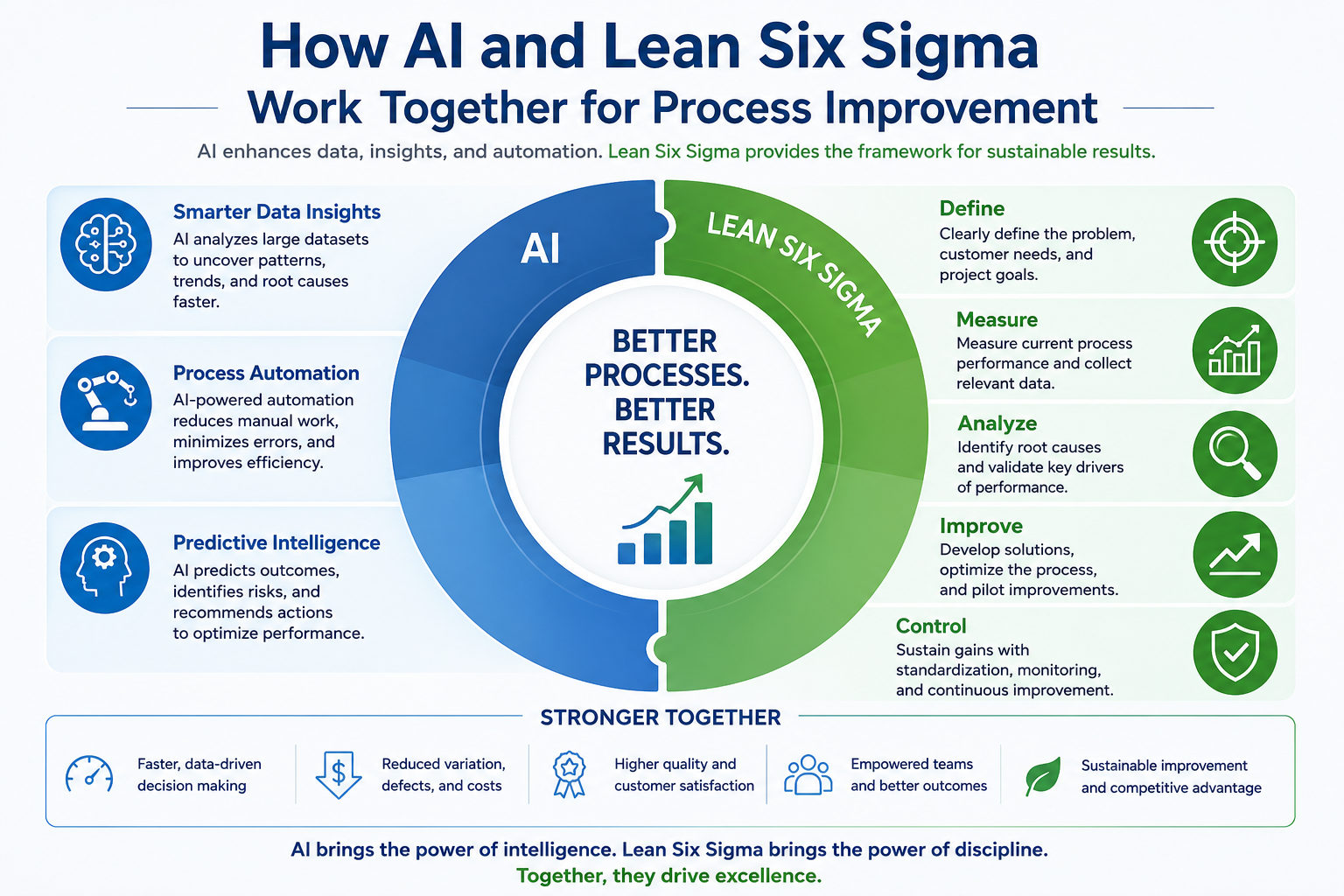
The integration of AI into Lean Six Sigma can significantly enhance process improvement efforts. Here are some ways AI contributes to this collaboration:
1. Data Analysis and Insights
AI can process and analyze massive datasets in real-time. This capability allows organizations to gain insights into their processes, identifying areas of inefficiency and potential improvements. By utilizing AI-driven analytics, companies can make data-informed decisions that lead to better process outcomes.
2. Predictive Analytics
With AI, businesses can leverage predictive analytics to forecast potential issues before they arise. This proactive approach allows teams to address problems before they escalate, ensuring smooth operations and improved quality.
3. Automation of Repetitive Tasks
AI can automate repetitive and mundane tasks, freeing up employees to focus on higher-value activities. This automation aligns with Lean principles by eliminating waste and optimizing resource allocation.
4. Continuous Improvement
The combination of AI and Lean Six Sigma fosters a culture of continuous improvement. AI can continuously monitor processes, identify deviations from the norm, and recommend corrective actions in real-time, ensuring that organizations are always operating at peak efficiency.
The Intersection of AI and Lean Six Sigma in Digital Transformation
As businesses undergo digital transformation in Six Sigma, the integration of AI becomes crucial. This transformation involves adopting digital technologies to enhance processes, improve customer experiences, and drive innovation. Here’s how AI and Lean Six Sigma intersect during this transformation:
1. Enhanced Decision-Making
Combining Lean Six Sigma with AI enables organizations to make more informed decisions. AI provides deeper insights into customer behavior, process performance, and market trends, allowing companies to adjust their strategies accordingly. This agility is vital in today's competitive environment.
2. Improved Customer Experience
AI can analyze customer feedback and behavior, helping organizations tailor their processes to better meet customer needs. By integrating Lean Six Sigma principles with AI capabilities, businesses can streamline their operations, leading to a more satisfying customer experience.
3. Real-Time Monitoring and Feedback
AI technologies facilitate real-time monitoring of processes, providing organizations with immediate feedback on performance metrics. This capability allows teams to respond quickly to any deviations from expected results, aligning with the continuous improvement ethos of Lean Six Sigma.
4. Training and Skill Development
As organizations adopt AI technologies, there is a growing need for training and skill development. Lean Six Sigma provides a framework for developing employees' skills in data analysis, problem-solving, and process management. This combination equips teams to leverage AI effectively in their improvement efforts.
Challenges in Integrating AI with Lean Six Sigma
While the integration of AI and Lean Six Sigma presents numerous advantages, it also comes with its challenges:
1. Data Quality and Availability
AI relies heavily on data, and the quality of this data is paramount. Organizations must ensure that they have access to accurate and relevant data for AI to yield meaningful insights. Poor data quality can lead to incorrect conclusions and ineffective process improvements.
2. Change Management
Integrating AI into existing Lean Six Sigma frameworks requires a cultural shift within organizations. Employees may resist adopting new technologies and processes. Effective change management strategies are essential to facilitate a smooth transition and encourage buy-in from all team members.
3. Skill Gaps
For successful integration, employees need the right skills to work with AI technologies. Organizations must invest in training programs to bridge any skill gaps and ensure employees are equipped to leverage AI in their Lean Six Sigma initiatives.
FAQs
1. What is the relationship between AI and Six Sigma?
AI enhances Six Sigma by providing advanced data analysis, predictive analytics, and automation capabilities, leading to improved process efficiency and quality.
2. Can AI replace Six Sigma methodologies?
No, AI complements Six Sigma methodologies. While AI can automate certain tasks and provide insights, the core principles of Lean Six Sigma, such as continuous improvement and waste reduction, remain essential.
3. How can organizations ensure successful integration of AI and Lean Six Sigma?
Organizations can ensure successful integration by focusing on data quality, investing in employee training, and implementing effective change management strategies to foster a culture of innovation.
4. What industries can benefit from AI and Lean Six Sigma integration?
Almost any industry can benefit from this integration, including manufacturing, healthcare, finance, and retail, as it leads to improved efficiency, quality, and customer satisfaction.
Conclusion
The convergence of AI and Six Sigma represents a significant opportunity for organizations looking to improve their processes and drive digital transformation. By leveraging AI's capabilities alongside Lean Six Sigma methodologies, businesses can enhance decision-making, streamline operations, and foster a culture of continuous improvement. As the business landscape continues to evolve, those who embrace this powerful combination will be well-positioned to thrive in an increasingly competitive market.
Call to Action
Are you ready to transform your processes and embrace the future of operational excellence? Contact us today to learn more about how integrating AI with Lean Six Sigma can drive significant improvements in your organization!