Latest Post
Quality Management Courses



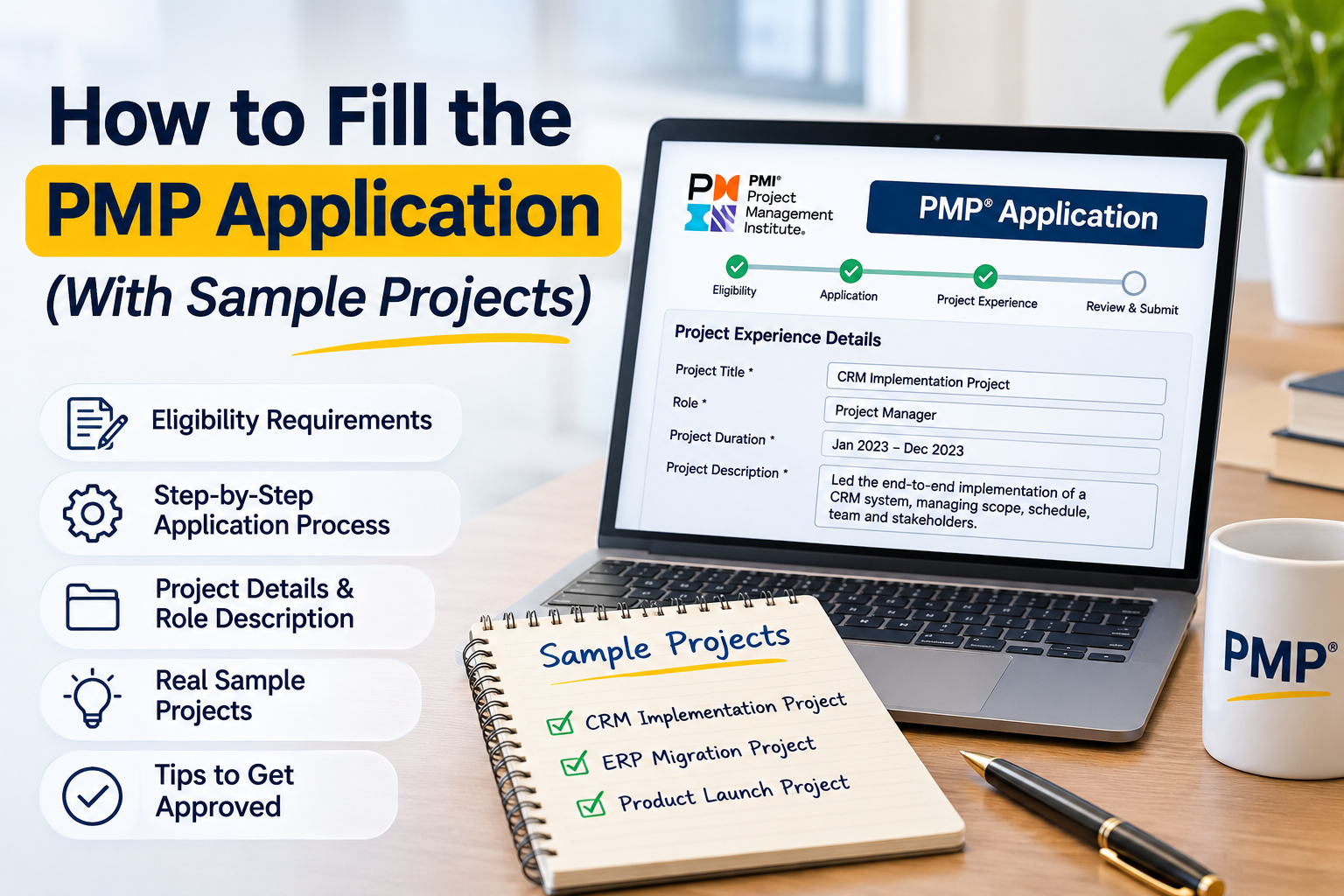

Many PMP candidates spend weeks preparing for the exam and then lose time at the very first step: the application. They describe their job instead of their projects, claim overlapping months, or write vague summaries that PMI sends back for revision. None of this is about ability. It is about knowing what PMI's reviewers want to see.
This guide walks through the PMP application section by section, shows how to describe your experience in a way reviewers recognise, and includes three sample project descriptions from IT, construction, and manufacturing that you can use as models.
Quick answer:
To fill the PMP application, create an account on pmi.org, then enter your education, your 35 hours of project management training, and your project experience. For each project, give the title, organisation, your role, dates, delivery approach, and a 200–500 word description covering the objective, your responsibilities across the project life cycle, key deliverables, and the outcome. PMI usually reviews online applications within about five business days. Keep proof of your training and contact details for your supervisors ready in case you are selected for audit.
Before You Start: Check Your Eligibility
The PMP has three requirements: education, experience, and project management training. Since the new exam launched in July 2026, qualifying experience can come from the last 10 years, which helps candidates with career breaks or role changes.
Your education, project experience, and training requirements: Four-year degree (bachelor's or global equivalent)36 months leading projects35 contact hours, or an active CAPM; Secondary education (Class 12, diploma or equivalent)60 months leading projects35 contact hours, or an active CAPM; Degree from a GAC-accredited programme24 months leading projects35 contact hours, or an active CAPM
PMI has said it is expanding eligibility pathways, so check the current PMP requirements on pmi.org before you apply. For a fuller explanation, see our guide to PMP eligibility requirements and the exam process.
What Counts as "Leading Projects"
You do not need the job title "Project Manager." PMI looks at what you did. Leading and directing project work includes planning activities, coordinating team members, managing schedules or budgets, handling risks and issues, communicating with stakeholders and driving delivery. Team leads, technical leads, site engineers, Scrum Masters, product owners and consultants often qualify.
What Does Not Count
- Routine operational work with no defined start and end, such as daily production or ongoing support
- Purely technical work, such as coding or design, where you did not lead or coordinate others
- Overlapping months: if two projects ran at the same time, those months count only once
Prepare These Details First
The online application must be completed within 90 days of starting it. Gathering everything beforehand saves frustration.
- Education: institution name, degree, and year of completion
- Training: course name, provider, dates and number of hours, plus your certificate
- Projects: a list of every project you plan to claim, with start and end months
- Contacts: name, email and phone of a supervisor or manager who can confirm each project
Build an Experience Tracker in Excel
Before you open the PMI portal, list your projects in a spreadsheet with columns for project name, organisation, role, start month, end month, approach (predictive, agile or hybrid), months claimed and contact person. Sort by date and check for overlaps. Many applicants discover they had fewer unique months than they thought. Our guide on creating a project plan in Excel covers the basic spreadsheet skills you need.
Step-by-Step: Filling the PMP Application
Step 1: Create Your PMI Account
Register at pmi.org using your name exactly as it appears on the government ID you will bring on exam day, such as your passport or Aadhaar card. A mismatch can cause problems at the test centre. If you plan to become a PMI member for the exam fee discount, join before you pay for the exam.
Step 2: Enter Your Education
Choose your highest level of education and enter the institution, degree and completion year. Be accurate. If you are audited, you will need to provide a copy of your degree or diploma.
Step 3: Add Your 35 Contact Hours
Enter the course title, the training provider, the dates you attended and the number of qualifying hours. The training must cover project management topics and be completed before you apply. If you hold an active CAPM, you can use it instead. Keep the completion certificate handy.
Step 4: Add Your Project Experience
This is the section that decides whether your application moves smoothly. For each project, PMI asks for:
- Project title and organisation
- Your job title and functional reporting area
- Start and end dates (month and year)
- Project approach: predictive, agile or hybrid
- Team size and budget range, where requested
- A project description of roughly 200 to 500 words
Step 5: Review, Agree and Submit
Read every entry once more. Check that dates do not overlap, that totals meet the requirement, and that the language is consistent. Agree to PMI's terms and submit. PMI typically reviews online applications within about five business days.
How to Write a Project Description PMI Approves
Use a Simple Four-Part Structure
- Objective: one sentence on what the project set out to achieve.
- Your role: what you were responsible for, and who you led.
- Your work across the life cycle: what you did when starting, planning, executing, monitoring and closing the project, or the agile equivalents.
- Outcome: what was delivered and, if possible, a measurable result.
Writing Tips That Make a Difference
Write in the First Person
Use "I led," "I prepared," "I tracked." Reviewers want to know what you did, not what the team did.
Use Project Management Language
Words such as project charter, stakeholder register, work breakdown structure, risk register, change request, sprint planning, backlog refinement and lessons learned show that you understand the work in PMI's terms.
Keep Technical Detail to a Minimum
Reviewers do not need the database version or the grade of concrete. One line of context is enough. Spend the words on management activities.
Match the Approach You Selected
If you mark a project as agile, describe agile activities such as backlog, sprints, reviews and retrospectives. If it was hybrid, show both.
Write Your Own Words
Use the samples below as models, not templates to copy. Reviewers notice near-identical descriptions, and copied text can lead to rejection.
Sample PMP Project Descriptions
The following are illustrative samples written for this guide. Adapt the structure to your own project, and describe only work you actually did.
Sample 1: IT Project (Agile)
Project: Customer self-service mobile app | Role: Scrum Master / Delivery Lead | Approach: Agile | Duration: 14 months
Objective: Build a mobile app that allows retail banking customers to raise and track service requests, reducing branch visits and call-centre load.
Role and responsibilities: I led a cross-functional team of nine developers, testers and designers, and worked with the product owner and business stakeholders.
Initiating and planning: I facilitated a discovery workshop with stakeholders to define the product vision and high-level roadmap, helped the product owner create and prioritise the initial backlog, agreed the definition of done with the team, and set up two-week sprints with a release plan.
Executing: I facilitated sprint planning, daily stand-ups, sprint reviews and retrospectives, removed impediments such as delayed API access from a vendor, and coordinated with security and compliance teams for approvals.
Monitoring and controlling: I tracked progress using burndown charts and velocity, managed risks in a shared risk log, and reported status to the steering committee every two weeks.
Closing: I coordinated production release, handed over to the support team, and led a project retrospective to capture lessons learned.
Outcome: The app launched in three releases. Within three months of launch, about 40% of service requests were raised through the app.
Sample 2: Construction Project (Predictive)
Project: G+6 commercial office building | Role: Project Engineer / Site In-charge | Approach: Predictive | Duration: 20 months
Objective: Construct a seven-storey commercial office building in Noida within the approved budget and handover date.
Role and responsibilities: I managed site execution, led a team of four engineers and supervisors, and coordinated three subcontractors.
Initiating and planning: I reviewed the contract scope and drawings, prepared the work breakdown structure for civil and finishing works, developed the detailed schedule in MS Project, prepared the procurement plan for major materials, and identified site risks such as monsoon delays and labour availability.
Executing: I allocated crews and equipment, coordinated subcontractor work, conducted weekly coordination meetings with the client and architect, and managed material deliveries.
Monitoring and controlling: I tracked progress against the baseline schedule, monitored costs against budget, raised and tracked change requests for design revisions, and ensured quality inspections and safety audits were completed.
Closing: I completed the snag list, obtained client acceptance, handed over as-built drawings and documentation, and recorded lessons learned.
Outcome: The building was handed over two weeks behind the original date due to approved design changes, and within 3% of the revised budget.
Sample 3: Manufacturing Improvement Project (Hybrid)
Project: Packaging line rejection reduction | Role: Quality Lead / Project Lead | Approach: Hybrid | Duration: 7 months
Objective: Reduce rejections on a food packaging line from about 4% to below 1.5% to cut material waste and customer complaints.
Role and responsibilities: I led a team of six from production, maintenance and quality, reporting to the plant head as sponsor.
Initiating and planning: I prepared the project charter with goals, scope and benefits, identified stakeholders, created a phase plan using the DMAIC approach, and set up a risk register.
Executing: I led data collection and root cause analysis, then ran the improvement work in short two-week cycles, testing changes such as sealing temperature settings and a new inspection fixture, reviewing results with the team after each cycle.
Monitoring and controlling: I tracked rejection rates daily, reported weekly to the sponsor, and managed changes to the production schedule for trials.
Closing: I updated the SOPs, trained operators, handed over a control plan to the production team and documented lessons learned.
Outcome: Rejections fell to about 1.2% and remained stable for three months after handover.
Common Mistakes That Delay Applications
- Describing the job, not the project. "Responsible for managing IT operations" is a role. A project has a defined start, end and deliverable.
- Using "we" throughout. Reviewers need to see your personal leadership.
- Overlapping dates. Overlapping months count only once. Claiming them twice can trigger questions.
- Too much technical detail. Long explanations of technology leave no room for management activities.
- Mismatched approach. Marking a project as agile but describing only a Gantt chart and sign-offs raises doubts.
- Unverifiable claims. If your supervisor would not recognise the description, rewrite it.
What Happens After You Submit
If Your Application Is Approved
You will receive an email asking you to pay the exam fee. Once paid, you can schedule your exam with Pearson VUE at a test centre or online. Your eligibility period is one year, and you can attempt the exam up to three times within it.
If You Are Selected for Audit
PMI randomly selects a percentage of applications for audit. Being selected does not mean anything is wrong. You will typically be asked to provide:
- A copy of your degree or diploma
- Your 35-hour training certificate
- Signed confirmation from your supervisors for each project listed
You usually have 90 days to submit the documents. Contact your supervisors before you apply, so they know what to expect and can sign quickly. If someone has left the company, a colleague who worked with you and can verify the project may be acceptable; check PMI's audit instructions.
If PMI Asks for Changes
Sometimes PMI returns an application with a request to clarify a description. Read the feedback carefully, revise only what is asked, and resubmit.
Frequently Asked Questions
How long should each PMP project description be?
PMI's online application asks for a description of roughly 200 to 500 words per project. Aim for around 250 to 350 well-chosen words covering objective, role, life-cycle activities and outcome.
How long does PMI take to review the application?
Online applications are usually reviewed within about five business days. If you are selected for audit, the process takes longer, depending on how quickly you submit your documents.
Can I include projects from a previous company?
Yes. Any qualifying project within the last 10 years counts, regardless of employer, as long as someone can verify your role if you are audited.
Do I need the title "Project Manager" to apply?
No. PMI looks at the work you did. If you led and directed project activities, your experience can qualify under any job title.
What happens if I fail the audit?
If you cannot provide the required documents, or they do not support your claims, your application will not be approved. Being honest and accurate from the start is the best protection.
Can I save the application and finish later?
Yes. You can save your progress, but you must submit within 90 days of starting. After that, the application expires.
Final Thoughts
A strong PMP application is clear, honest and written in your own words. Map your projects in a tracker first, describe what you personally led across the project life cycle, and let your supervisors know they may be contacted. Done well, the application takes a few evenings and moves through review without delay, so you can focus on the exam itself.
Our PMP certification training includes the 35 contact hours, a review of your project descriptions before you submit, and preparation for the 2026 PMP exam. If you do not yet have enough experience, our CAPM training is a strong first step. You may also find our guide on building a resume for project management roles useful.