
Latest Post


.png)

Quality Management Courses



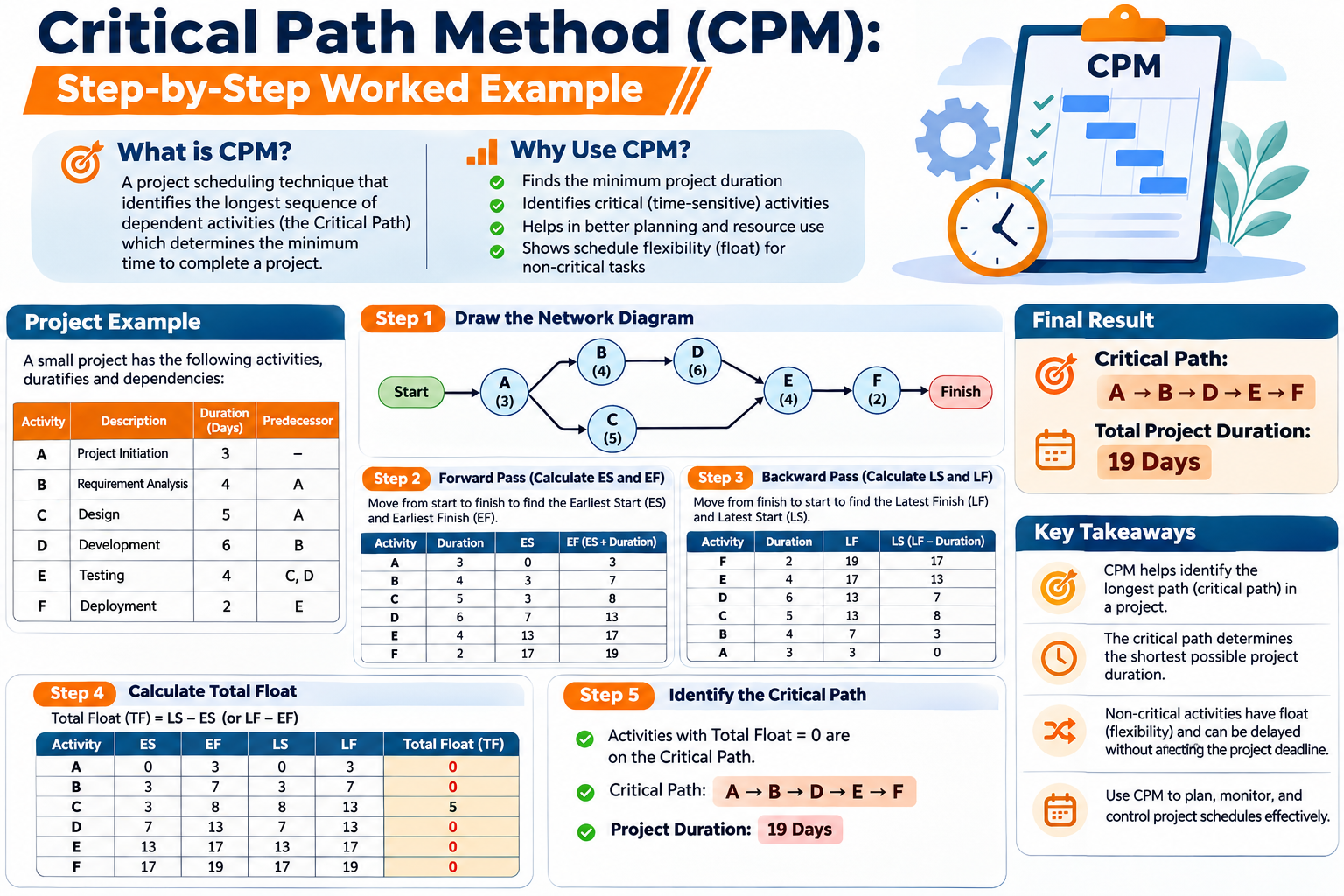

Every project has a handful of tasks that decide when it finishes. Delay any of them by a day and the go-live date moves by a day. Delay other tasks and nothing happens at all. The trouble is that these deciding tasks are rarely obvious from a task list. The critical path method (CPM) finds them, so you know exactly where to focus your attention, your best people and your schedule buffers.
This guide walks through the critical path method one step at a time, using a small website project that you can follow with pen and paper or in Excel.
Quick answer: The critical path is the longest sequence of dependent activities in a project, and it sets the shortest possible project duration. To find it: (1) list activities, durations and dependencies; (2) draw a network diagram; (3) run a forward pass to find early start and early finish; (4) run a backward pass to find late start and late finish; (5) calculate float (LS − ES). Activities with zero float form the critical path. Any delay to them delays the whole project.
What Is the Critical Path Method?
The critical path method is a scheduling technique that identifies the chain of activities with no flexibility. It was developed in the late 1950s for large industrial projects and is still used today in construction, manufacturing, IT, events and infrastructure.
Why It Matters
- It tells you the real project duration. Adding up all task durations overstates it, because many tasks run in parallel.
- It shows where to focus. Critical activities need the closest monitoring and the strongest people.
- It reveals flexibility. Non-critical activities have float, so you can move them to balance workloads.
- It supports better decisions. When a deadline is brought forward, you know which tasks to speed up and which ones would waste money.
Key Terms You Need to Know
Table 1: Key critical path termsTermMeaningFormulaDuration (D)Time needed to complete an activityFrom estimatesEarly Start (ES)Earliest day an activity can beginLargest EF of all predecessors (0 for the first activity)Early Finish (EF)Earliest day an activity can endEF = ES + DLate Finish (LF)Latest day an activity can end without delaying the projectSmallest LS of all successors (project end for the last activity)Late Start (LS)Latest day an activity can begin without delaying the projectLS = LF − DTotal FloatHow long an activity can slip without delaying the projectTotal Float = LS − ES (or LF − EF)Free FloatHow long an activity can slip without delaying the next activityFree Float = smallest ES of successors − EF
This guide uses the "day 0" convention, where the first activity starts at day 0 and finishes at the end of its duration. Some textbooks start at day 1. Both give the same critical path; just stay consistent.
Step 1: List Activities, Durations and Dependencies
Imagine a team planning the launch of a company website. After breaking down the work, they have this activity list:
Table 2: Activity list for the website launch projectIDActivityDuration (days)Predecessor(s)AGather requirements3NoneBDesign layouts5ACWrite content4ADDevelop website7BEPrepare content for upload2CHSet up SEO and analytics2BFTest website3D, EGGo live1F, H
A good activity list depends on a solid work breakdown. If your tasks are too large to estimate, break them down further first. Our guide to creating a project plan in Excel covers task breakdown and dependencies.
Step 2: Draw the Network Diagram
Draw each activity as a box (node) and connect boxes with arrows to show dependencies. This is called the activity-on-node or precedence diagramming method. For our project:
- A leads to both B and C.
- B leads to D and H.
- C leads to E.
- D and E both lead to F.
- F and H both lead to G.
Once drawn, list every path from start to finish and add up its durations.
Table 3: All paths through the networkPathCalculationTotal durationCritical?A → B → D → F → G3 + 5 + 7 + 3 + 119 daysYesA → C → E → F → G3 + 4 + 2 + 3 + 113 daysNo (6 days float)A → B → H → G3 + 5 + 2 + 111 daysNo (8 days float)
The longest path, A–B–D–F–G at 19 days, is the critical path. For small projects, listing paths like this is enough. For larger ones, the forward and backward pass method below is faster and also gives you float for every activity.
Step 3: Run the Forward Pass
The forward pass moves from left to right through the network to find the earliest each activity can start and finish.
- The first activity starts at 0.
- EF = ES + Duration.
- When an activity has several predecessors, its ES is the largest EF among them, because it cannot start until all of them are finished.
Table 4: Forward pass (early start and early finish)ActivityDurationEarly Start (ES)Early Finish (EF)How ES was foundA303First activity starts at 0B538EF of A = 3C437EF of A = 3D7815EF of B = 8E279EF of C = 7H2810EF of B = 8F31518Larger of EF of D (15) and E (9)G11819Larger of EF of F (18) and H (10)
The project's earliest finish is day 19, the EF of the last activity.
Step 4: Run the Backward Pass
The backward pass moves from right to left to find the latest each activity can start and finish without delaying the project.
- The last activity's LF equals the project end (19).
- LS = LF − Duration.
- When an activity has several successors, its LF is the smallest LS among them.
Table 5: Backward pass (late finish and late start)ActivityLate Finish (LF)Late Start (LS)How LF was foundG1918Project end = 19F1815LS of G = 18H1816LS of G = 18D158LS of F = 15E1513LS of F = 15B83Smaller of LS of D (8) and H (16)C139LS of E = 13A30Smaller of LS of B (3) and C (9)
Step 5: Calculate Float and Identify the Critical Path
Total float shows how much an activity can slip without delaying the project. Free float shows how much it can slip without delaying the next activity.
Table 6: Complete critical path schedule with floatActivityDESEFLSLFTotal FloatFree FloatCritical?A – Requirements3030300YesB – Design5383800YesC – Content43791360NoD – Development781581500YesE – Content upload prep279131566NoH – SEO setup2810161888NoF – Testing31518151800YesG – Go live11819181900Yes
Reading the Results
Activities A, B, D, F and G have zero float, confirming the critical path of A → B → D → F → G with a project duration of 19 days.
Content writing (C) has 6 days of total float but zero free float. If C slips, it eats into E's float, so the content team should not assume they have six "spare" days each. The SEO setup (H) has 8 days of float, so the team could start it later or assign it to someone who is busy in week two.
What to Do with the Critical Path
Protect Critical Activities
Assign experienced people to critical tasks, remove distractions for them, and check progress more often. A two-day delay in development (D) moves the launch by two days; a two-day delay in SEO setup (H) changes nothing.
Use Float to Balance Workload
Non-critical tasks can be shifted within their float to smooth resource peaks. This is the basis of resource levelling.
Watch for Near-Critical Paths
A path with only one or two days of float can become critical after a small delay. Monitor these too. This is one of the common reasons projects get delayed without warning.
Shortening the Schedule: Crashing and Fast-Tracking
When a sponsor asks for an earlier date, only shortening critical activities helps. There are two standard techniques.
Table 7: Schedule compression techniquesTechniqueWhat it meansMain riskExampleCrashingAdding resources to critical activities to finish them fasterHigher costAdding a second developer to Activity DFast-trackingRunning activities in parallel that were planned in sequenceMore rework if early work changesStarting testing on finished pages while development continues
Worked Example: Meeting a 16-Day Deadline
The client now wants the website live in 16 days instead of 19. The team finds that development (D) can be shortened by up to 2 days by adding a second developer at ₹15,000 per day saved, and testing (F) by 1 day with an extra tester at ₹20,000.
Table 8: Crashing the website project to meet a 16-day deadlineStepActionDays savedExtra costNew durationCritical path still?1Crash D (Development) by 2 days with a second developer2₹30,00017 daysYes, A–B–D–F–G2Crash F (Testing) by 1 day with an extra tester1₹20,00016 daysYes, A–B–D–F–GTotal—3₹50,00016 daysOther paths (13 and 11 days) still have float
After each change, the team checks that the critical path has not shifted. Here, the other paths (13 and 11 days) still have enough float, so the deadline is met for an extra ₹50,000. Shortening non-critical tasks such as content writing would have cost money and saved no time at all.
Critical Path in Excel
You can calculate the critical path in Excel with a few simple formulas. Set up columns for ID, activity, duration, ES, EF, LF, LS, float and a critical flag.
Table 9: Critical path formulas in Excel (headers in row 3, activities A to G in rows 4 to 11 in the order of Table 2)ColumnFieldFormula patternExample for Activity F (row 10)CDurationEnter estimate3DEarly Start (ES)=MAX(EF cells of all predecessors), or 0 for the first activity=MAX(E7,E8)EEarly Finish (EF)=ES + Duration=D10+C10FLate Finish (LF)=MIN(LS cells of all successors), or project end for the last activity=MIN(G11)GLate Start (LS)=LF − Duration=F10-C10HTotal Float=LS − ES=G10-D10ICritical?Flag activities with zero float=IF(H10=0,"Yes","No")
Fill ES and EF from top to bottom, then LF and LS from bottom to top. Add conditional formatting to highlight rows where float is zero. For larger projects, tools such as Microsoft Project, Primavera P6 or GanttProject calculate the critical path automatically.
Critical Path in Agile and Hybrid Projects
Pure agile teams rarely use CPM inside a sprint, because work is prioritised from a backlog rather than scheduled in a fixed sequence. But in hybrid projects, which are now common in Indian IT and infrastructure, the critical path is still useful at the release or programme level. For example, a mobile app release may depend on a vendor's payment integration, a security audit and app store approval. Mapping those dependencies shows which external milestones control the launch date. Our article on agile vs waterfall for Indian companies explains when each approach fits.
Common Mistakes with the Critical Path
- Missing dependencies. A forgotten link makes the schedule look shorter than it really is.
- Ignoring resource limits. CPM assumes unlimited resources. If one designer is needed for two parallel tasks, the real schedule is longer.
- Treating float as free time. Float is shared along a path. Using it early leaves nothing for later activities.
- Not updating the schedule. The critical path can change as work progresses. Recalculate after significant delays or changes.
- Crashing non-critical tasks. Spending money on tasks with float does not shorten the project.
Critical Path on the PMP and CAPM Exams
Critical path questions appear on both exams. You may be asked to identify the critical path from a network diagram, calculate float, or decide the best response to a schedule delay. Since the PMP exam's July 2026 update, graphic-based questions are more common, so practise reading network diagrams quickly. Read our guide to the new PMP exam in 2026 for preparation tips, and pair this topic with earned value management, which measures whether the schedule is being achieved in practice.
Exam Tips
- The critical path is the longest path, which gives the shortest project duration.
- Forward pass takes the largest EF; backward pass takes the smallest LS.
- Critical activities have zero total float (in an unconstrained schedule).
- A project can have more than one critical path, which increases schedule risk.
- Crashing adds cost; fast-tracking adds risk.
Frequently Asked Questions
What is the critical path in project management?
The critical path is the longest sequence of dependent activities from the start to the end of a project. It determines the minimum time needed to complete the project. Any delay to an activity on the critical path delays the whole project.
How do you calculate float?
Total float = Late Start − Early Start, or Late Finish − Early Finish. Activities with zero total float are on the critical path.
Can a project have more than one critical path?
Yes. If two or more paths have the same longest duration, they are all critical. This increases risk because delays on any of them will delay the project.
What is the difference between total float and free float?
Total float is how long an activity can be delayed without delaying the project end date. Free float is how long it can be delayed without delaying the early start of the next activity.
What is the difference between crashing and fast-tracking?
Crashing shortens critical activities by adding resources, which increases cost. Fast-tracking runs activities in parallel that were planned in sequence, which increases the risk of rework.
Can the critical path change during a project?
Yes. If a non-critical activity is delayed beyond its float, or a critical activity finishes early, a different path can become critical. Recalculate the schedule regularly.
Final Thoughts
The critical path method answers two questions every project manager faces: how long will this really take, and which tasks can I not afford to let slip? Once you can run a forward and backward pass confidently, you can protect the activities that matter, use float wisely, and respond to deadline pressure with facts rather than guesswork.
Learn scheduling, earned value and the full project management toolkit in our PMP certification training, or start with our CAPM course if you are new to project management. You may also find our guides on managing multiple projects without missing deadlines, weekly project status reports and the PMBOK 8th Edition useful.