Latest Post


Quality Management Courses



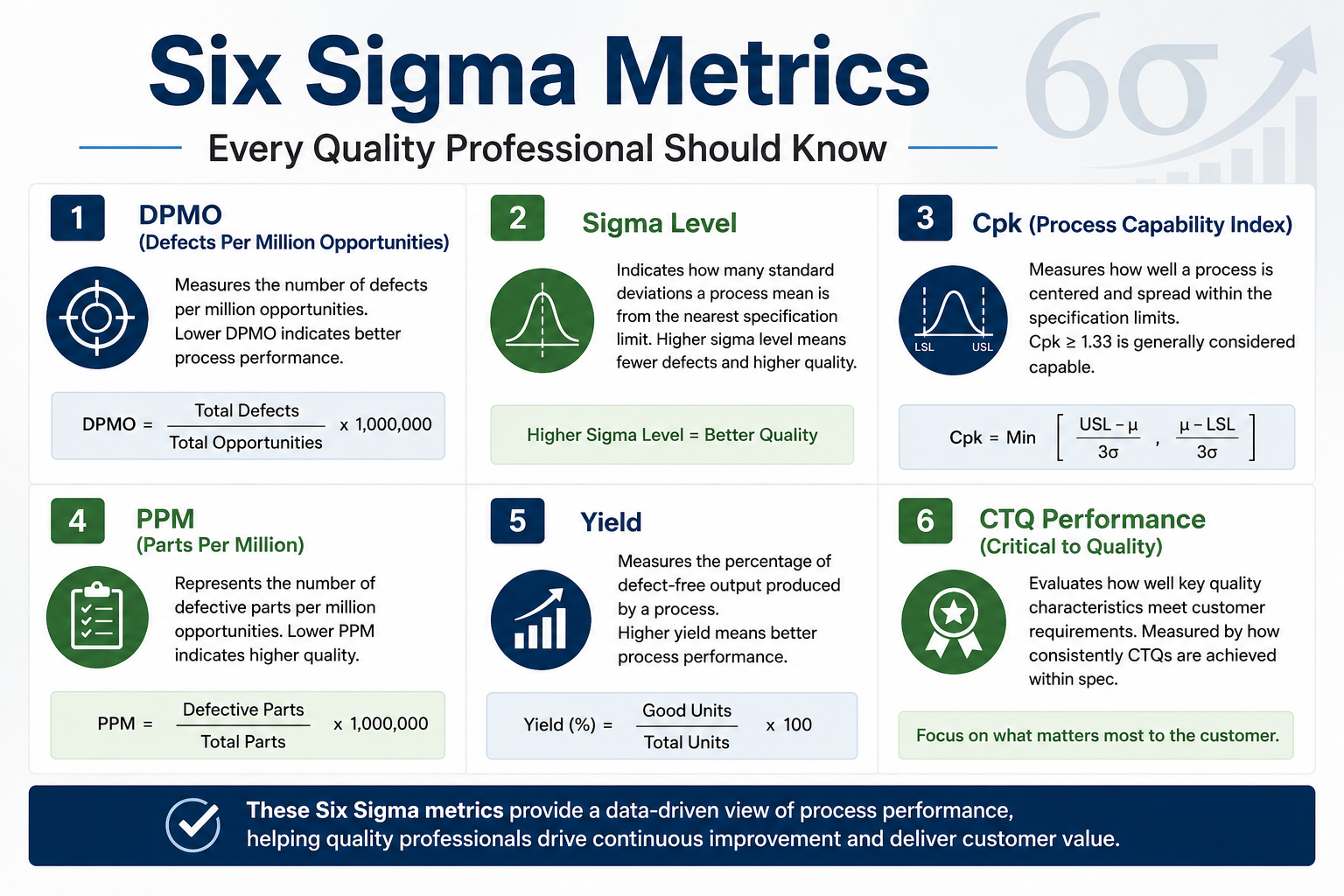

In today's competitive business environment, maintaining quality standards is essential for success. For quality professionals in India, understanding Six Sigma metrics is crucial in driving improvement initiatives and ensuring process excellence. This blog will explore six key Six Sigma metrics that every quality professional should be well-versed in to enhance their quality management strategies.
What is Six Sigma?
Six Sigma is a data-driven methodology that focuses on reducing defects and improving processes. It aims for near perfection by minimizing variability and improving quality. The term "Six Sigma" represents a statistical concept where the goal is to achieve fewer than 3.4 defects per million opportunities. By employing Six Sigma principles, organizations can enhance their quality management metrics and improve overall performance.
Key Six Sigma Metrics to Know
1. Defects Per Million Opportunities (DPMO)
Defects Per Million Opportunities (DPMO) is a critical Six Sigma metric that quantifies the number of defects in a process per million opportunities. It helps organizations understand how many mistakes occur in their processes and where improvements are needed.
Formula: DPMO = (Number of Defects / (Number of Opportunities x Number of Units)) x 1,000,000
For example, if a company produces 1,000 units and encounters 50 defects, the DPMO would be calculated as follows:
DPMO = (50 / (1,000 x 1)) x 1,000,000 = 50,000
This metric provides valuable insights into process performance and highlights areas for improvement.
2. Process Capability Index (Cpk)
The Process Capability Index (Cpk) measures how well a process can produce output within specified limits. It reflects the ability of a process to meet customer specifications consistently. A higher Cpk value indicates a more capable process.
Formula: Cpk = min (Cpu, Cpl)
Where:
A Cpk value greater than 1.33 is generally considered acceptable, while a value above 2 is outstanding. Quality professionals in India can use this metric to assess if their processes are capable of meeting customer requirements consistently.
3. Sigma Level
The Sigma Level is a measure of process performance that indicates how many standard deviations fit between the process mean and the nearest specification limit. It is a vital metric for understanding the quality level of a process.
A higher Sigma Level corresponds to fewer defects and higher quality. For example, a process that operates at a 6 Sigma level has only 3.4 defects per million opportunities, indicating a high level of quality.
Quality professionals can use this metric to benchmark their processes against industry standards and strive for continuous improvement.
4. Overall Equipment Effectiveness (OEE)
Overall Equipment Effectiveness (OEE) is a comprehensive metric that measures the efficiency of manufacturing operations. It considers availability, performance, and quality to provide a holistic view of equipment effectiveness.
Formula: OEE = Availability x Performance x Quality
Where:
A high OEE score indicates that equipment is running efficiently, producing high-quality products with minimal downtime. Quality professionals can leverage OEE to identify areas of improvement and optimize production processes.
5. First Pass Yield (FPY)
First Pass Yield (FPY) measures the percentage of products that are manufactured correctly without rework. It is a vital process performance metric that reflects the effectiveness of a production process.
Formula: FPY = (Number of Good Units / Total Units Produced) x 100
A higher FPY indicates that the process is efficient and produces a higher percentage of acceptable products. Quality professionals should aim for an FPY of 95% or higher to ensure quality standards are met consistently.
6. Cost of Poor Quality (COPQ)
The Cost of Poor Quality (COPQ) encompasses all costs associated with defects and failures in a process. This metric includes costs related to rework, scrap, warranty claims, and lost sales due to poor quality. Understanding COPQ helps organizations identify the financial impact of quality issues.
By analyzing COPQ, quality professionals can prioritize improvement initiatives and allocate resources effectively to enhance overall quality.
Why Understanding Six Sigma Metrics is Essential
Understanding Six Sigma metrics is essential for quality professionals in India for several reasons:
FAQs on Six Sigma Metrics
What is the primary goal of Six Sigma?
The primary goal of Six Sigma is to improve the quality of processes by identifying and eliminating defects, thereby reducing variability and enhancing customer satisfaction.
How can I implement Six Sigma metrics in my organization?
To implement Six Sigma metrics, begin by training your team on the principles of Six Sigma. Identify key processes to measure, collect data, and analyze it using the metrics discussed in this blog. Set clear targets for improvement and monitor progress continuously.
Can Six Sigma metrics be applied to non-manufacturing sectors?
Yes, Six Sigma metrics can be applied to various sectors, including services, healthcare, and finance. The principles of process improvement and quality management are universally applicable.
How often should Six Sigma metrics be reviewed?
Six Sigma metrics should be reviewed regularly, ideally on a monthly or quarterly basis. This ensures that the organization stays on track with its quality improvement goals and can make timely adjustments as needed.
Conclusion
As a quality professional in India, mastering Six Sigma metrics is essential to drive process improvements and enhance overall quality management. By understanding and applying these metrics, you can make informed decisions, foster a culture of continuous improvement, and ultimately achieve greater customer satisfaction.
Are you ready to take your quality management to the next level? Start implementing these Six Sigma metrics today and watch your processes transform! For more insights and expert guidance on quality management, subscribe to our newsletter or contact us directly!