
Latest Post



Quality Management Courses



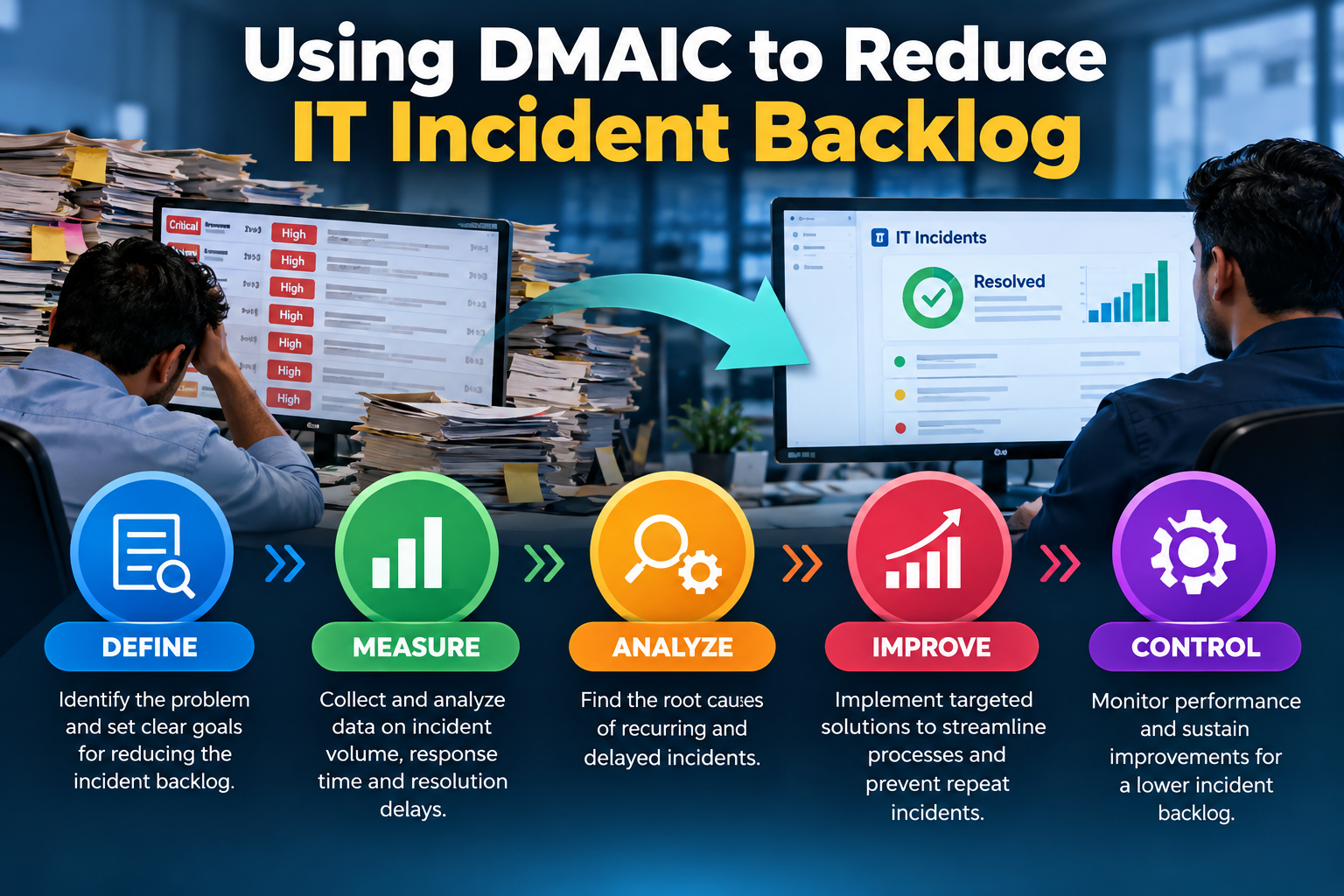

In today’s fast-paced digital landscape, efficient IT operations are paramount for businesses to thrive. A significant challenge faced by many organizations is the accumulation of IT incidents, which can lead to operational inefficiencies and decreased customer satisfaction. One effective methodology to tackle this issue is DMAIC—a data-driven quality strategy used to improve processes. In this blog, we will explore how to effectively use DMAIC to reduce IT incident backlog, ensuring smoother operations and enhanced service delivery.
What is DMAIC?
DMAIC stands for Define, Measure, Analyze, Improve, and Control. It is a core component of Six Sigma, a set of techniques and tools for process improvement. The DMAIC framework provides a structured approach to problem-solving, which can be particularly useful in IT environments facing incident management challenges.
Understanding IT Incident Backlog
Before delving into DMAIC, it's essential to understand what an IT incident backlog is. An IT incident backlog occurs when the volume of reported incidents exceeds the capacity of the IT support team to manage them. This backlog can lead to longer resolution times, frustrated users, and a dip in service quality. In India, where businesses are rapidly digitizing, managing this backlog has become more crucial than ever.
Step 1: Define
The first step in the DMAIC process is to clearly define the problem. For IT incident backlogs, this involves identifying the scope of the backlog, understanding the types of incidents being reported, and determining the impact on business operations.
Key Actions in the Define Phase:
For instance, your goal might be to reduce the backlog by 30% within the next quarter. Clear goals will help guide the subsequent steps in the DMAIC process.
Step 2: Measure
Once the problem is defined, the next step is to measure the current state of the IT incident backlog. This step is about collecting relevant data that can inform your analysis.
Key Actions in the Measure Phase:
Using tools like incident management software can help automate data collection, providing a clearer picture of the backlog and its components.
Step 3: Analyze
In the analysis phase, the goal is to identify the root causes of the IT incident backlog. This involves using various analytical tools and techniques to understand why incidents are accumulating.
Key Actions in the Analyze Phase:
By understanding the root causes, organizations can target their improvement efforts more effectively.
Step 4: Improve
The improvement phase is where you develop and implement solutions to address the identified root causes of the backlog. This step is critical for achieving the reduction in IT incident backlog.
Key Actions in the Improve Phase:
For instance, automating ticketing systems or improving self-service options can significantly reduce the burden on IT support teams.
Step 5: Control
The final step in the DMAIC process is to control the improvements made to ensure they are sustained over time. This involves monitoring the processes to ensure that the incident backlog remains manageable.
Key Actions in the Control Phase:
By putting controls in place, organizations can maintain a stable incident management process and prevent future backlogs.
Benefits of Using DMAIC to Reduce IT Incident Backlog
Implementing the DMAIC methodology to reduce IT incident backlog offers several benefits, especially for businesses in India:
Conclusion
Reducing IT incident backlog is essential for maintaining operational efficiency and ensuring customer satisfaction. By leveraging the DMAIC methodology, organizations can systematically address the root causes of their backlog, implement effective solutions, and establish controls to sustain improvements. In a rapidly evolving digital landscape, embracing such structured approaches can be the key to staying competitive and providing exceptional service.
FAQs
What is DMAIC used for?
DMAIC is used for process improvement, helping organizations define problems, measure performance, analyze root causes, implement improvements, and control processes to ensure sustained results.
How can DMAIC help in IT incident management?
DMAIC provides a structured framework to identify the causes of IT incident backlogs, implement effective solutions, and monitor performance, ultimately leading to improved efficiency and customer satisfaction.
What are some tools used in the DMAIC process?
Common tools include cause-and-effect diagrams, Pareto charts, control charts, and process mapping. These tools help organizations visualize data and identify areas for improvement.
Call to Action
If your organization is struggling with an IT incident backlog, consider implementing the DMAIC methodology today. Take the first step towards enhancing your IT processes and improving customer satisfaction. For more insights or assistance, feel free to contact us.