Latest Post




Quality Management Courses




In today's competitive market, maintaining quality is not just a necessity but a cornerstone for success. Whether you are involved in manufacturing, services, or any sector that values quality, understanding and utilizing the right seven QC tools is essential for any quality professional. This blog aims to explore these quality control tools that can significantly enhance your quality management tools arsenal, ensuring process improvement and customer satisfaction.
What Are QC Tools?
Quality Control (QC) tools are critical in identifying defects, analyzing processes, and driving improvements. They simplify complex data and provide actionable insights. By leveraging these basic quality tools, organizations can enhance their operational efficiency and improve their products or services.
The Seven QC Tools
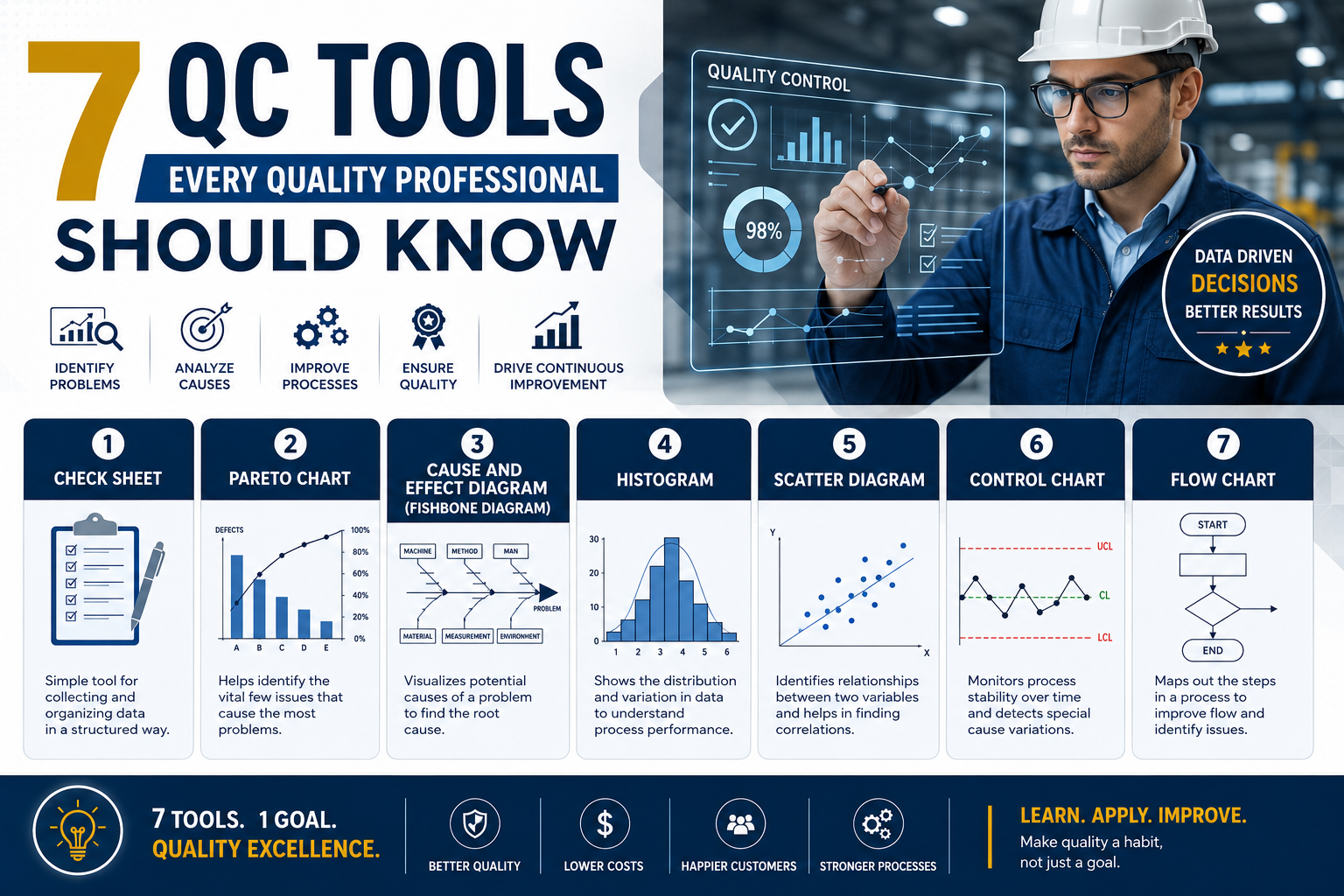
Here’s a detailed look at the seven QC tools every quality professional should have in their toolkit:
1. Check Sheets
Check sheets are simple yet effective tools used for data collection. They help in tracking the frequency of problems, defects, or issues over time. By using check sheets, quality professionals can easily identify patterns and areas that require attention. For instance, in a manufacturing setup, a check sheet can help track the number of defective products produced over a week, allowing for timely corrective actions.
2. Control Charts
Control charts are vital in monitoring process stability. They display data points over time and help quality teams determine if a process is in control or needs adjustments. By analyzing variations in data, quality professionals can discern between common cause variation and special cause variation. This understanding is crucial for implementing effective process improvement tools.
3. Fishbone Diagrams
Also known as Ishikawa or cause-and-effect diagrams, fishbone diagrams help identify potential causes of a problem. By visually mapping out the various factors that could contribute to an issue, teams can systematically address root causes rather than just symptoms. This tool fosters collaborative problem-solving and encourages team members to think critically about the quality issues at hand.
4. Pareto Charts
The Pareto principle, or the 80/20 rule, states that 80% of problems are often caused by 20% of the issues. Pareto charts visually represent the frequency of problems and their impacts, allowing quality professionals to prioritize their efforts on the most significant issues. By focusing on these key areas, organizations can maximize their quality improvement efforts.
5. Histogram
Histograms are graphical representations of the distribution of data. They provide insight into the variability of a process and help identify trends, patterns, and outliers. By analyzing histograms, quality professionals can understand how well a process is performing and what adjustments may be necessary for optimal results. This tool is essential for presenting data in a way that’s easy to understand and act upon.
6. Scatter Diagrams
Scatter diagrams depict the relationship between two variables. By plotting data points on a graph, quality professionals can visualize correlations and determine if one variable affects another. This tool is vital for root cause analysis and helps teams understand complex relationships within their processes.
7. Flowcharts
Flowcharts are visual representations of processes that outline the steps involved in a task or system. They are invaluable for identifying inefficiencies, redundancies, and potential points of failure within a process. By mapping out workflows, quality professionals can pinpoint areas for improvement and streamline operations, making them an essential part of any quality management tools toolkit.
Why Are These QC Tools Important?
Understanding and utilizing these seven QC tools can lead to significant improvements in quality management and process efficiency. They not only help in identifying and rectifying issues but also empower teams to adopt a proactive approach towards quality. By integrating these quality control tools into daily operations, organizations can enhance their overall performance and customer satisfaction.
Implementing QC Tools in India
In India, where industries are rapidly evolving, embracing these basic quality tools is crucial for staying competitive. From manufacturing hubs in Maharashtra to IT centers in Bangalore, adopting effective quality management practices can lead to higher standards and better compliance with global quality benchmarks. Organizations should invest in training and knowledge transfer to ensure that their teams are well-versed in using these tools effectively.
FAQs
1. What are the basic quality tools?
The basic quality tools include check sheets, control charts, fishbone diagrams, Pareto charts, histograms, scatter diagrams, and flowcharts. These tools help in data collection, analysis, and process improvement.
2. How can I choose the right QC tool for my organization?
Choosing the right QC tool depends on the specific challenges and goals of your organization. Assess your quality issues, data needs, and team capabilities to determine which tools will be most effective in addressing your unique situation.
3. Are these tools applicable to all industries?
Yes, while these quality management tools are widely used in manufacturing, they are also applicable in service industries, healthcare, education, and more. The principles of quality control are universal.
4. How do I train my team to use these tools effectively?
Invest in training programs, workshops, and hands-on sessions to equip your team with the necessary skills. Encourage a culture of continuous improvement and collaboration to foster effective tool usage.
Conclusion
In conclusion, mastering these seven QC tools can empower quality professionals and organizations alike to enhance their quality management processes. By implementing these process improvement tools, businesses in India can ensure superior quality, customer satisfaction, and operational efficiency. Start integrating these tools into your quality management strategy today, and watch your organization thrive!
Call to Action: Are you ready to elevate your quality management practices? Subscribe to our newsletter for more insights and tips on quality control and continuous improvement!