
Latest Post





Quality Management Courses



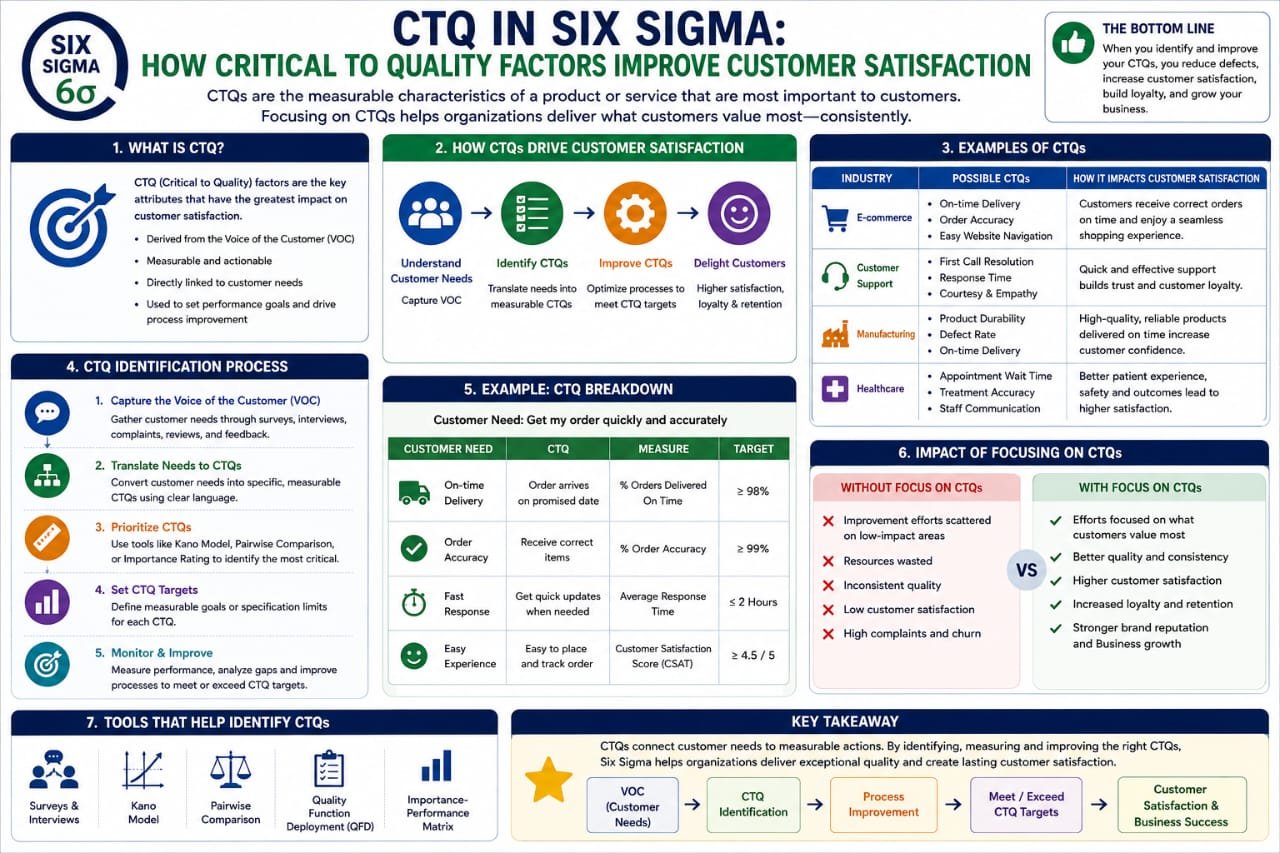

In the competitive landscape of modern business, understanding the needs and expectations of your customers is paramount. One of the most effective methodologies to achieve this is Six Sigma, and at the heart of this approach lies the concept of CTQ, or Critical to Quality. This blog will delve into the significance of CTQ in Six Sigma, explore its components, and illustrate how CTQ factors can enhance customer satisfaction in an Indian context.
What is CTQ in Six Sigma?
CTQ, or Critical to Quality, refers to the key measurable characteristics of a product or service that are essential for meeting customer requirements. In simpler terms, CTQs are the attributes that matter most to customers and directly influence their satisfaction. By identifying and focusing on these critical quality characteristics, businesses can improve their processes, reduce defects, and ultimately enhance customer satisfaction.
The Importance of CTQ in Enhancing Customer Satisfaction
Every business aims to deliver products or services that meet or exceed customer expectations. This is where CTQ plays a pivotal role. By understanding what is critical to quality from the customer's perspective, organizations can align their processes to deliver better outcomes. Here are a few key reasons why CTQ is essential:
1. Aligns Business Goals with Customer Needs
CTQ ensures that the business processes are directly aligned with what customers value. When organizations focus on critical quality characteristics, they are more likely to meet customer needs effectively. This alignment not only leads to improved quality but also fosters customer loyalty.
2. Reduces Process Variability
By implementing CTQ analysis, businesses can identify variations in their processes that may lead to defects or inconsistencies in product quality. Reducing variability ensures that customers receive a consistent experience, which is crucial for maintaining satisfaction and trust.
3. Facilitates Continuous Improvement
CTQ is not just a one-time analysis; it fosters a culture of continuous improvement. Regularly revisiting and updating CTQs based on changing customer expectations allows businesses to stay ahead of the curve and adapt to market demands.
Understanding the CTQ Tree
The CTQ Tree is a visual tool that helps organizations break down customer needs into specific, measurable characteristics. It transforms broad customer expectations into actionable quality measures. Here’s how it works:
1. Customer Requirements
The first step in the CTQ Tree is to gather the voice of the customer. This involves collecting feedback through surveys, interviews, or focus groups to identify what customers truly value.
2. Critical Quality Characteristics
Once customer requirements are identified, the next step is to translate these into critical quality characteristics. For example, if customers desire faster delivery times, "delivery speed" becomes a critical quality characteristic.
3. Measurable CTQs
Finally, each critical quality characteristic is broken down into measurable CTQs. For the "delivery speed" example, a measurable CTQ could be "95% of orders delivered within 2 days." This specificity helps teams focus on achieving concrete goals.
Conducting CTQ Analysis
CTQ analysis involves a systematic approach to identifying and measuring critical quality factors. Here’s a step-by-step guide on how to conduct CTQ analysis:
1. Gather Voice of Customer (VoC) Data
Start by collecting data that reflects customer opinions, preferences, and expectations. This can be done through surveys, customer feedback forms, or social media listening. The goal is to have a clear understanding of what customers consider important.
2. Identify Critical Quality Characteristics
Based on the VoC data, identify which characteristics are most critical to quality. This may include aspects like product durability, service speed, or customer support responsiveness.
3. Define Measurable CTQs
For each critical quality characteristic, develop measurable CTQs that can be tracked over time. Ensure that these measurements are realistic and aligned with customer expectations.
4. Monitor and Analyze
Regularly monitor the performance of these CTQs. Use statistical tools to analyze data and identify trends. This will help in pinpointing areas for improvement.
5. Implement Changes and Reassess
Once you identify areas needing improvement, implement necessary changes in your processes. After making adjustments, reassess the CTQs to ensure customer satisfaction is being met.
Real-World Applications of CTQ in Indian Businesses
In India, businesses across various sectors are leveraging CTQ in Six Sigma to enhance customer satisfaction. Here are a few examples:
1. E-commerce
With the rapid growth of e-commerce in India, companies like Flipkart and Amazon are using CTQ analysis to understand customer preferences better. By focusing on critical quality characteristics such as delivery time and product quality, these companies have significantly improved customer satisfaction.
2. Manufacturing
Indian manufacturers are adopting Six Sigma methodologies to improve product quality. By identifying CTQs related to durability and performance, they can minimize defects and enhance customer trust in their products.
3. Service Industry
In the service sector, businesses such as banks and telecom providers are utilizing CTQ analysis to enhance customer experiences. By focusing on aspects like response time and service reliability, they can tailor their offerings to meet customer expectations.
FAQs
What is the role of CTQ in Six Sigma?
CTQ plays a crucial role in Six Sigma by helping organizations identify the critical quality characteristics that matter most to customers, thereby enabling targeted improvements to enhance customer satisfaction.
How can I gather Voice of Customer data effectively?
Effective methods for gathering VoC data include surveys, interviews, focus groups, and analyzing customer feedback on social media platforms. The key is to ask the right questions that reflect customer needs and preferences.
Can CTQ analysis be applied to all industries?
Yes, CTQ analysis can be applied across various industries, including manufacturing, service, healthcare, and e-commerce. The approach may vary, but the underlying principles remain the same.
Conclusion
CTQ in Six Sigma is not just a methodology; it’s a commitment to understanding and meeting customer needs. By focusing on critical quality characteristics and implementing effective CTQ analysis, businesses can significantly enhance customer satisfaction and loyalty. In the ever-evolving Indian market, adopting these practices can give organizations a competitive edge.
If you’re looking to implement CTQ in your business processes or need assistance with Six Sigma methodologies, contact us today! Let us help you transform your customer satisfaction levels through quality improvements.