
Latest Post





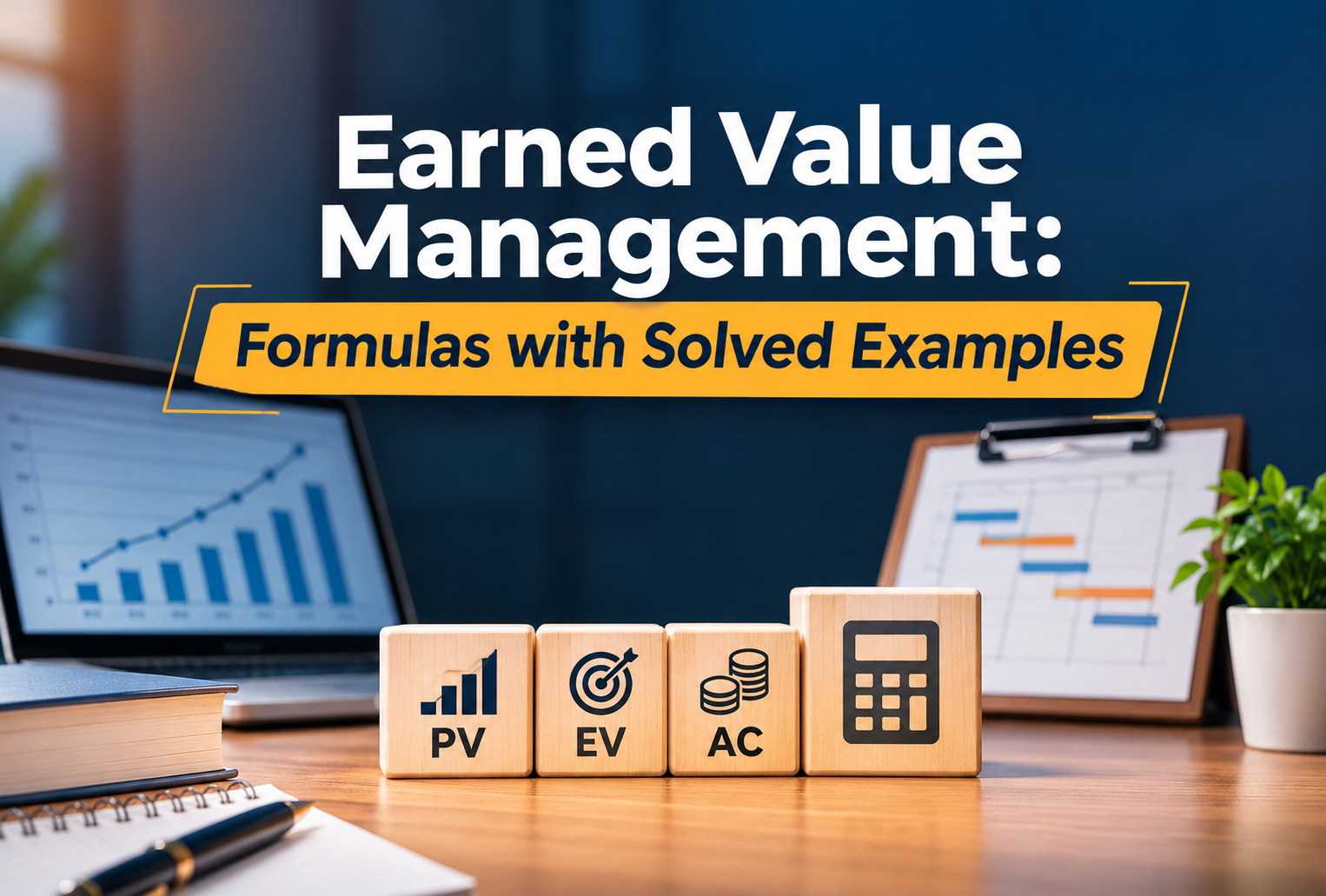

"Are we on track?" is the question every sponsor asks, and the answer is often a vague "mostly." The budget report says half the money is spent. The schedule says half the time is gone. But neither tells you how much work is actually done, and that is the number that matters. Earned value management (EVM) connects all three, so you can say with confidence whether a project is over budget, behind schedule, or both, and what it is likely to cost by the end.
This guide explains every earned value formula in plain language, works through a complete example in rupees, and shows how to set it up in Excel.
Quick answer: Earned value management compares three figures: Planned Value (PV), the budgeted cost of work scheduled; Earned Value (EV), the budgeted cost of work actually completed; and Actual Cost (AC), what was really spent. The key formulas are CV = EV − AC, SV = EV − PV, CPI = EV ÷ AC and SPI = EV ÷ PV. A CPI or SPI below 1 means the project is over budget or behind schedule. The forecast total cost is commonly calculated as EAC = BAC ÷ CPI.
What Is Earned Value Management?
Earned value management is a method for measuring project performance by comparing the work planned, the work completed and the money spent, all expressed in the same unit: the budget. It gives an objective picture of progress, rather than relying on gut feeling or percentages that teams report optimistically.
Why Budget and Schedule Reports Are Not Enough
Imagine a project has spent 50% of its budget halfway through its schedule. That looks perfect. But if only 30% of the work is complete, the project is in trouble on both cost and time. Without measuring work completed, you cannot see the problem until it is too late to fix.
Where EVM Is Used
EVM is common in construction, infrastructure, defence, aerospace, government contracts and large IT programmes. It is also a standard topic in the PMP and CAPM exams. Even if your organisation does not use it formally, the thinking behind it will make you a sharper project manager.
The Four Building Blocks
Every earned value calculation starts with four numbers.
Table 1: The four building blocks of earned value. Term, Full form, What it means, Question it answers, BAC, Budget at Completion: Total approved budget for the project. How much should the whole project cost?PVPlanned ValueBudgeted cost of the work scheduled to be done by now. How much work should we have done by today?EVEarned ValueBudgeted cost of the work actually completed by nowHow much work have we really done, in budget terms?AC Actual Cost: Money actually spent on the work completed so far. How much have we spent to get here?
How to Calculate Earned Value
The simplest method is: EV = % of work actually completed × BAC. If a ₹10 lakh project is 40% complete, EV is ₹4 lakh, regardless of how much has been spent or how much time has passed.
Measuring "% complete" honestly is the hardest part. Common methods include:
- 0/100 rule: a task earns nothing until it is finished. Simple and conservative.
- 50/50 rule: a task earns half its value when started and the rest when finished.
- Milestone method: value is earned when defined milestones are achieved.
- Physical measurement: for example, metres of pipe laid or pages of a website built.
Earned Value Formulas Explained
Table 2: Earned value formulas at a glanceMetricFormulaHow to read itCost Variance (CV)CV = EV − ACNegative = over budget; positive = under budgetSchedule Variance (SV)SV = EV − PVNegative = behind schedule; positive = aheadCost Performance Index (CPI)CPI = EV ÷ ACBelow 1 = over budget; above 1 = under budgetSchedule Performance Index (SPI)SPI = EV ÷ PVBelow 1 = behind schedule; above 1 = aheadEstimate at Completion (EAC)EAC = BAC ÷ CPI (most common)Forecast total cost if current cost performance continuesEstimate to Complete (ETC)ETC = EAC − ACMoney still needed to finishVariance at Completion (VAC)VAC = BAC − EACExpected overrun (negative) or saving (positive) at the endTo-Complete Performance Index (TCPI)TCPI = (BAC − EV) ÷ (BAC − AC)Cost efficiency needed on remaining work to finish within BAC
Variances: How Far Off Are We?
Cost Variance (CV) shows the difference between the value of work done and what it cost. Schedule Variance (SV) shows the difference between work done and work planned. Both are in money terms. Negative is bad; positive is good.
Indices: How Efficient Are We?
The Cost Performance Index (CPI) and Schedule Performance Index (SPI) express performance as ratios, which makes it easy to compare projects of different sizes. A CPI of 0.9 means you get 90 paise of work for every rupee spent. An SPI of 1.1 means you are progressing 10% faster than planned.
Forecasts: Where Will We End Up?
Estimate at Completion (EAC) forecasts the total project cost. Estimate to Complete (ETC) shows how much more money is needed. Variance at Completion (VAC) shows the expected overrun or saving at the end. The To-Complete Performance Index (TCPI) tells you how efficiently the remaining work must be done to meet the budget.
Solved Example: A Website Development Project
An illustrative example to show each calculation step by step.
A digital agency in Delhi is building a corporate website. The approved budget is ₹10 lakh over 10 weeks, with work planned evenly across the period. At the end of week 5, the project manager reviews progress.
Table 3: Website project status at the end of week 5ItemValueHow it was worked outBudget at Completion (BAC)₹10,00,000Approved project budgetPlanned Value (PV)₹5,00,00050% of work was scheduled by week 5 × BACEarned Value (EV)₹4,00,00040% of work actually completed × BACActual Cost (AC)₹4,80,000Total spent so far, from timesheets and invoices
Step-by-Step Calculations
Table 4: Solved earned value calculations for the website projectMetricCalculationResultWhat it tells the project managerCV4,00,000 − 4,80,000−₹80,000₹80,000 over budget for the work doneSV4,00,000 − 5,00,000−₹1,00,000₹1,00,000 worth of work behind scheduleCPI4,00,000 ÷ 4,80,0000.83Getting about 83 paise of work for every rupee spentSPI4,00,000 ÷ 5,00,0000.80Progressing at 80% of the planned rateEAC10,00,000 ÷ 0.8333 (CPI unrounded)₹12,00,000Project likely to cost ₹12 lakh if the trend continuesETC12,00,000 − 4,80,000₹7,20,000Still needed to finishVAC10,00,000 − 12,00,000−₹2,00,000Expected overrun of ₹2 lakhTCPI(10,00,000 − 4,00,000) ÷ (10,00,000 − 4,80,000)1.15Remaining work must be done 15% more efficiently to stay within budget
What the Project Manager Should Do
The numbers tell a clear story: the project is both over budget and behind schedule. With a CPI of 0.83 and SPI of 0.80, the team is working less efficiently than planned and also not producing enough work. A TCPI of 1.15 means the team would need to become 15% more cost-efficient on the remaining work to finish within budget, which is rarely realistic without changes.
Sensible next steps include finding the root cause (for example, repeated design revisions from the client), raising a change request if the scope has grown, re-planning the remaining work, and telling the sponsor early about the likely ₹2 lakh overrun. Our guides on why projects get delayed and project risk management cover these responses in more detail.
Choosing the Right EAC Formula
There is more than one way to forecast total cost. The right formula depends on what you expect for the remaining work.
Table 5: Choosing the right EAC formulaSituationEAC formulaWebsite example resultCurrent cost performance will continue (most common)EAC = BAC ÷ CPI₹12,00,000The overrun was a one-off; remaining work will go to planEAC = AC + (BAC − EV)₹10,80,000Both cost and schedule problems will affect remaining workEAC = AC + [(BAC − EV) ÷ (CPI × SPI)]₹13,80,000The original plan is no longer validEAC = AC + bottom-up ETCDepends on the new estimate
The three results for the same project range from ₹10.8 lakh to ₹13.8 lakh. This is why a project manager must explain the assumption behind any forecast, not just the number.
How to Interpret CPI and SPI Together
Table 6: How to interpret CPI and SPI togetherCPISPIProject statusTypical response> 1> 1Under budget and ahead of scheduleConfirm estimates were realistic; check quality is not being cut> 1< 1Under budget but behind scheduleLook for under-resourcing; consider adding people or fast-tracking< 1> 1Over budget but ahead of scheduleCheck for overtime or premium resources; slow spending if possible< 1< 1Over budget and behind scheduleRoot cause analysis, re-plan, and escalate to the sponsor
Setting Up Earned Value in Excel
You do not need specialist software for basic EVM. A simple Excel sheet works well for weekly reporting.
Table 7: Earned value formulas in Excel (values in cells B2 to B5)CellLabelExcel formulaB2BACEnter valueB3PVEnter valueB4EVEnter valueB5ACEnter valueB7CV=B4-B5B8SV=B4-B3B9CPI=ROUND(B4/B5,2)B10SPI=ROUND(B4/B3,2)B11EAC=B2/(B4/B5)B12ETC=B11-B5B13VAC=B2-B11B14TCPI=ROUND((B2-B4)/(B2-B5),2)
Add conditional formatting to colour CPI and SPI red below 0.95, amber between 0.95 and 1, and green at 1 or above. Track the values every week and plot PV, EV and AC as lines on one chart. The gap between the lines shows trends at a glance. If you are new to project spreadsheets, start with our guide to creating a project plan in Excel, and use the results in your weekly project status report.
Earned Value in Agile Projects
EVM is often seen as a waterfall technique, but it can be adapted for agile work. In agile EVM, the release backlog's total story points represent the full scope, and completed story points at the end of each sprint represent earned value. Planned value comes from the number of sprints completed against the total planned. The same CPI and SPI logic then applies. Many hybrid projects use this approach to give sponsors a familiar cost view while teams work in sprints.
Common Mistakes with Earned Value
- Confusing EV with AC. Earned value is the budgeted value of work done, not money spent.
- Optimistic % complete. "90% done" tasks that stay at 90% for weeks distort EV. Use the 0/100 or 50/50 rules for short tasks.
- Using an outdated baseline. If approved changes are not added to BAC and PV, the numbers become meaningless.
- Relying on SPI near the end. SPI moves towards 1 as a late project finishes, even if it is late, because EV eventually equals PV. Look at actual dates too.
- Reporting numbers without explanation. Sponsors need the reason behind a CPI of 0.83 and what you plan to do about it.
Earned Value on the PMP and CAPM Exams
EVM questions appear on both the PMP and CAPM exams. Since the PMP exam changed in July 2026, it includes graphic-based questions, so you may be shown an S-curve chart or a performance table and asked to interpret it rather than simply calculate. Learn the formulas until you can recall them quickly, but focus on what the results mean and what action a project manager should take.
Memory Tips
- EV always comes first in variances and indices: CV = EV − AC, SV = EV − PV, CPI = EV/AC, SPI = EV/PV.
- Variance: subtract. Index: divide.
- Negative or below 1 is bad; positive or above 1 is good.
- C goes with AC (cost), S goes with PV (schedule).
For exam preparation, read our guide to the new PMP exam in 2026, and see how finance fits into the wider framework in our PMBOK 8th Edition explainer. If you are just starting out, our CAPM exam pattern guide is a good place to begin.
Frequently Asked Questions
What is earned value in project management?
Earned value is the budgeted cost of the work actually completed at a given point in time. It is calculated as the percentage of work complete multiplied by the total budget (BAC).
What is the formula for CPI?
CPI = EV ÷ AC. A CPI below 1 means the project is over budget; above 1 means it is under budget.
What is the formula for SPI?
SPI = EV ÷ PV. An SPI below 1 means the project is behind schedule; above 1 means it is ahead.
What is the difference between EAC and ETC?
EAC (Estimate at Completion) is the forecast total cost of the whole project. ETC (Estimate to Complete) is the cost still needed to finish. ETC = EAC − AC.
What does a TCPI greater than 1 mean?
It means the remaining work must be done more efficiently than the work so far in order to finish within budget. A TCPI well above 1 usually signals that the budget target is unrealistic.
Can earned value management be used in agile projects?
Yes. Agile EVM uses story points completed as a measure of earned value, and sprints completed as a measure of planned progress. The same CPI and SPI formulas then apply.
Final Thoughts
Earned value management turns "we're mostly on track" into a clear, measurable answer. Learn the four building blocks, practise the formulas on a real or sample project, and always pair the numbers with an explanation and a plan of action. That combination is what sponsors value, and what the PMP exam now tests.
Build these skills properly with our PMP certification training, which covers earned value with practice questions and case studies, or begin with our CAPM training if you are early in your career. Planning to apply for the PMP? Read how to fill the PMP application.