
Latest Post



Quality Management Courses



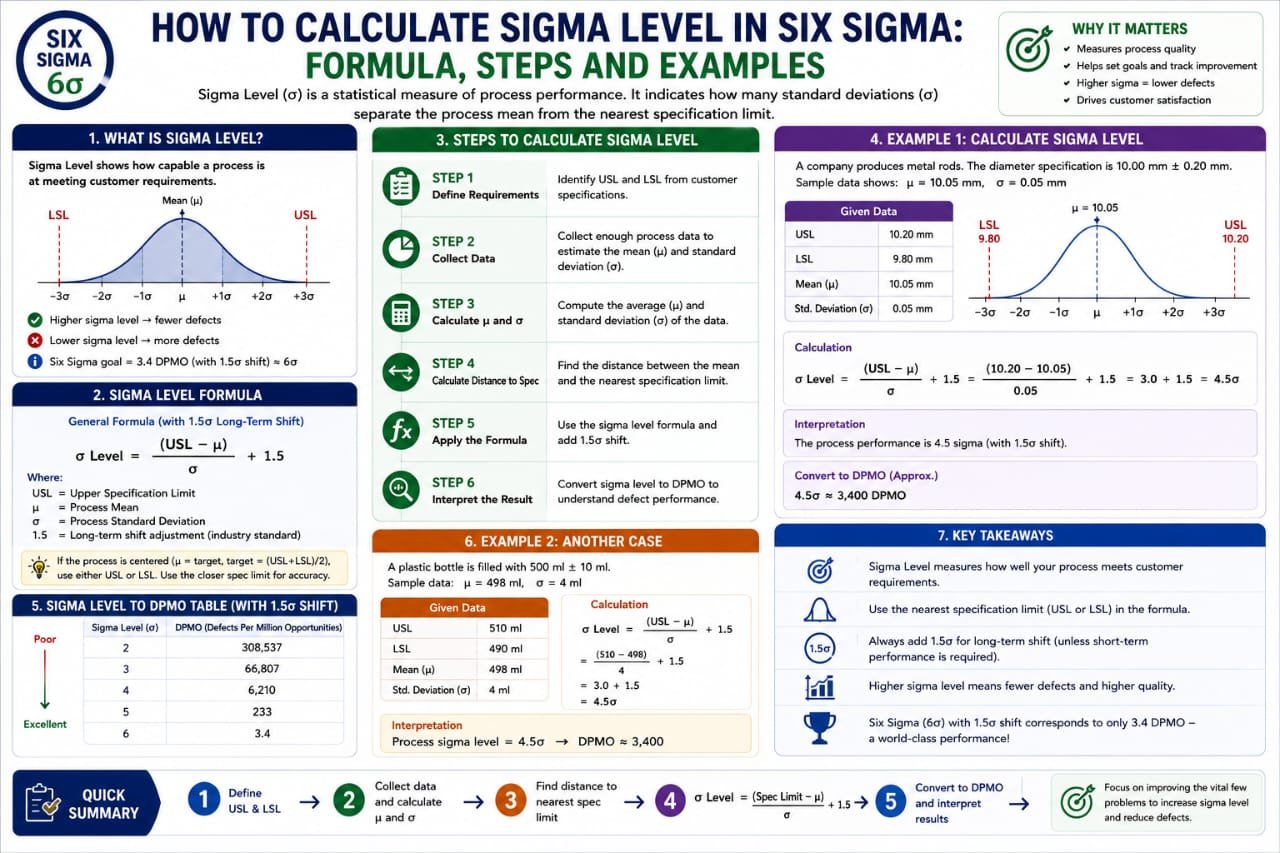

In the world of quality management, Six Sigma stands as a powerful methodology aimed at improving processes and reducing defects. At the heart of Six Sigma lies a critical concept known as the sigma level, which quantifies how well a process is performing. In this blog, we will explore sigma level calculation, the sigma level formula, and step-by-step examples to help you grasp how to calculate sigma level effectively. Whether you're in manufacturing, services, or any other industry in India, mastering this aspect of Six Sigma can significantly enhance your operational efficiency.
Understanding Sigma Levels
The sigma level is a statistical measure that indicates how much a process deviates from perfection. In Six Sigma, a higher sigma level corresponds to fewer defects per million opportunities (DPMO). The ultimate goal of Six Sigma is to achieve a sigma level of 6, which equates to only 3.4 defects per million opportunities.
What is Sigma Level Calculation?
Sigma level calculation is a method used to determine the performance of a process relative to its specifications. It helps organizations identify areas of improvement and monitor progress over time. By understanding how to calculate sigma level, you can set realistic performance goals and drive continuous improvement.
Sigma Level Formula
The sigma level formula is based on the number of defects in a given process. Here’s the formula you need to calculate sigma level:
Sigma Level = (USL - Mean) / Standard Deviation
Where:
Steps to Calculate Sigma Level
Calculating sigma level may seem complex, but with a systematic approach, you can easily determine the sigma level of your processes. Here are the steps:
Step 1: Define the Process
Identify the specific process you want to analyze. This could be anything from a manufacturing line to a customer service process. Clearly define the scope and objectives of the analysis.
Step 2: Gather Data
Collect data related to the process performance. You will need data on the number of defects, the total opportunities for defects, and any relevant specifications. Ensure that your data is accurate and representative of the process.
Step 3: Calculate Defects per Million Opportunities (DPMO)
To calculate DPMO, use the following formula:
DPMO = (Number of Defects / Total Opportunities) x 1,000,000
This will give you a clearer picture of how many defects occur per million opportunities.
Step 4: Determine the Mean and Standard Deviation
Calculate the mean (average) of your process data and the standard deviation, which measures how spread out the data points are. You can use statistical tools or software to assist you in these calculations.
Step 5: Apply the Sigma Level Formula
Now that you have the mean, standard deviation, and USL, plug these values into the sigma level formula:
Sigma Level = (USL - Mean) / Standard Deviation
Step 6: Interpret the Results
Once you have calculated the sigma level, interpret the results. A sigma level of 3.4 defects per million opportunities signifies a Six Sigma process, while a sigma level of 2 corresponds to 308,537 defects per million opportunities. Understanding where your process stands helps in setting goals for improvement.
Sigma Level Examples
Let’s look at a couple of examples to solidify your understanding of sigma level calculation.
Example 1: Manufacturing Process
Imagine a manufacturing plant that produces components with a USL of 10mm. After collecting data, the mean of the components produced is 9.5mm, with a standard deviation of 0.5mm.
Using the sigma level formula:
Sigma Level = (10 - 9.5) / 0.5 = 1
This indicates a sigma level of 1, meaning the process needs improvement to reduce defects.
Example 2: Customer Service Process
Consider a customer service center that receives 1,000 calls, with 50 of those resulting in complaints (defects). The USL for response time is set at 5 minutes.
First, calculate DPMO:
DPMO = (50 / 1,000) x 1,000,000 = 50,000
Next, assume the mean response time is 4.5 minutes, and the standard deviation is 0.5 minutes:
Sigma Level = (5 - 4.5) / 0.5 = 1
Similar to the manufacturing example, this indicates a need for improvement.
FAQs on Sigma Level Calculation
What is a good sigma level?
A sigma level of 6 (3.4 defects per million opportunities) is considered world-class, while a sigma level of 3 (66,807 defects per million opportunities) is the minimum acceptable level in many industries.
How often should I calculate my sigma level?
It is advisable to calculate your sigma level regularly, especially after implementing process improvements or changes. This helps track progress and identify new areas for improvement.
Can I use Six Sigma in service industries?
Absolutely! Six Sigma principles can be applied to service industries, including healthcare, finance, and customer service, to improve efficiency and customer satisfaction.
Conclusion
Understanding how to calculate sigma level is essential for any organization looking to improve its processes and reduce defects. By following the steps outlined in this blog, you can effectively assess your process performance and set realistic improvement goals. Remember, achieving a higher sigma level is not just about numbers; it’s about fostering a culture of continuous improvement within your organization.
Ready to take your process improvement journey to the next level? Start applying the sigma level calculation today and watch your operational efficiency soar!
Call to Action
If you found this blog helpful, don’t forget to share it with your colleagues and friends! For more insights on Six Sigma and quality management, subscribe to our newsletter or contact us for personalized consulting services.