
Latest Post





Quality Management Courses



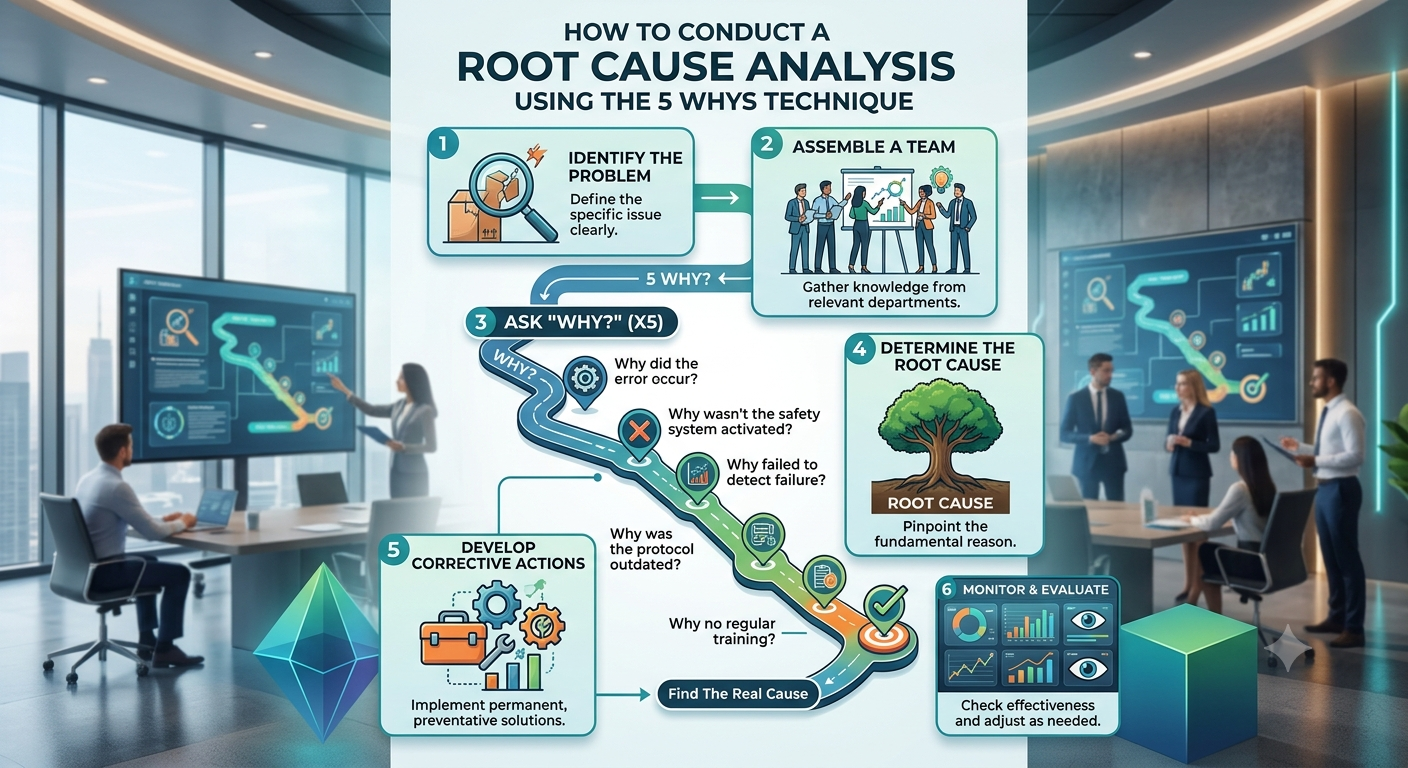

In today’s fast-paced world, organizations are constantly seeking ways to improve their processes and enhance the quality of their products and services. One of the most effective problem-solving techniques is the 5 Whys analysis, a simple yet powerful tool that helps identify the root cause of an issue. In this blog, we will explore how to conduct a root cause analysis using the 5 Whys technique, its significance in quality improvement, and how it fits within the framework of Lean Six Sigma tools.
Understanding Root Cause Analysis
Root cause analysis (RCA) is a systematic approach to identifying the underlying reasons for a problem. Instead of merely treating the symptoms, RCA aims to uncover the root cause, enabling organizations to implement effective solutions that prevent recurrence. The 5 Whys technique is a popular method for conducting RCA, especially in manufacturing and service sectors.
What is the 5 Whys Technique?
The 5 Whys analysis is a problem-solving method developed by Sakichi Toyoda, the founder of Toyota Industries. It involves asking "why" five times (or as many times as needed) to delve deeper into the cause of a problem. This iterative questioning helps teams to uncover the core issue rather than just addressing the superficial symptoms.
Why Use the 5 Whys Technique?
The 5 Whys technique is particularly useful because:
Steps to Conduct a 5 Whys Analysis
Step 1: Define the Problem
Begin by clearly articulating the problem you want to analyze. This should be a specific and measurable issue. For instance, instead of saying "We have low sales," a better formulation would be, "Our sales dropped by 20% in the last quarter."
Step 2: Assemble a Team
Gather a cross-functional team that includes individuals who are familiar with the process or product in question. This diversity will bring in different perspectives, enriching the analysis.
Step 3: Ask "Why?"
Start with the problem statement and ask why it is occurring. Write down the answer and keep asking "why" for each subsequent answer. Aim to reach the root cause by the fifth "why." Here’s an example:
Step 4: Identify the Root Cause
Once you have reached the fifth "why," you should have a clearer understanding of the root cause. The next step involves validating this root cause to ensure it is indeed the true issue and not just a surface-level explanation.
Step 5: Develop Solutions
Now that you have identified the root cause, brainstorm potential solutions with your team. Consider both immediate actions and long-term strategies to address the root cause effectively.
Step 6: Implement and Monitor
Put the chosen solutions into action and monitor their effectiveness. Make adjustments as necessary to ensure that the problem does not recur.
Integrating 5 Whys with Quality Improvement Tools
The 5 Whys technique is often used in conjunction with other quality improvement tools and methodologies, such as Lean and Six Sigma. Here’s how it fits into these frameworks:
Benefits of Using 5 Whys Analysis
Implementing the 5 Whys technique offers numerous advantages:
FAQs
What are some common pitfalls to avoid when using the 5 Whys technique?
Some common pitfalls include stopping too early (not asking enough "whys"), jumping to conclusions without sufficient analysis, and failing to involve a diverse team in the discussion.
Can the 5 Whys technique be used for complex problems?
Yes, while the technique is straightforward, it can be adapted for complex problems by continuing to ask "why" beyond five times if necessary, or by integrating other problem-solving tools.
How does the 5 Whys technique compare to other root cause analysis methods?
Unlike more complex methods like Fishbone diagrams or Fault Tree Analysis, the 5 Whys technique is simple and quick, making it accessible for teams with limited resources.
Conclusion
The 5 Whys technique is a powerful tool for conducting root cause analysis, making it an essential part of problem-solving techniques in any organization. By fostering a culture of inquiry and collaboration, businesses can not only resolve issues more effectively but also drive continuous improvement. If you're looking to enhance your organization's problem-solving capabilities, consider integrating the 5 Whys analysis into your quality improvement initiatives.
Call to Action
Are you ready to take your problem-solving skills to the next level? Start implementing the 5 Whys analysis in your organization today! For more insights on quality improvement tools and Lean Six Sigma techniques, subscribe to our newsletter and stay updated with the latest trends and tips.