Latest Post



Quality Management Courses



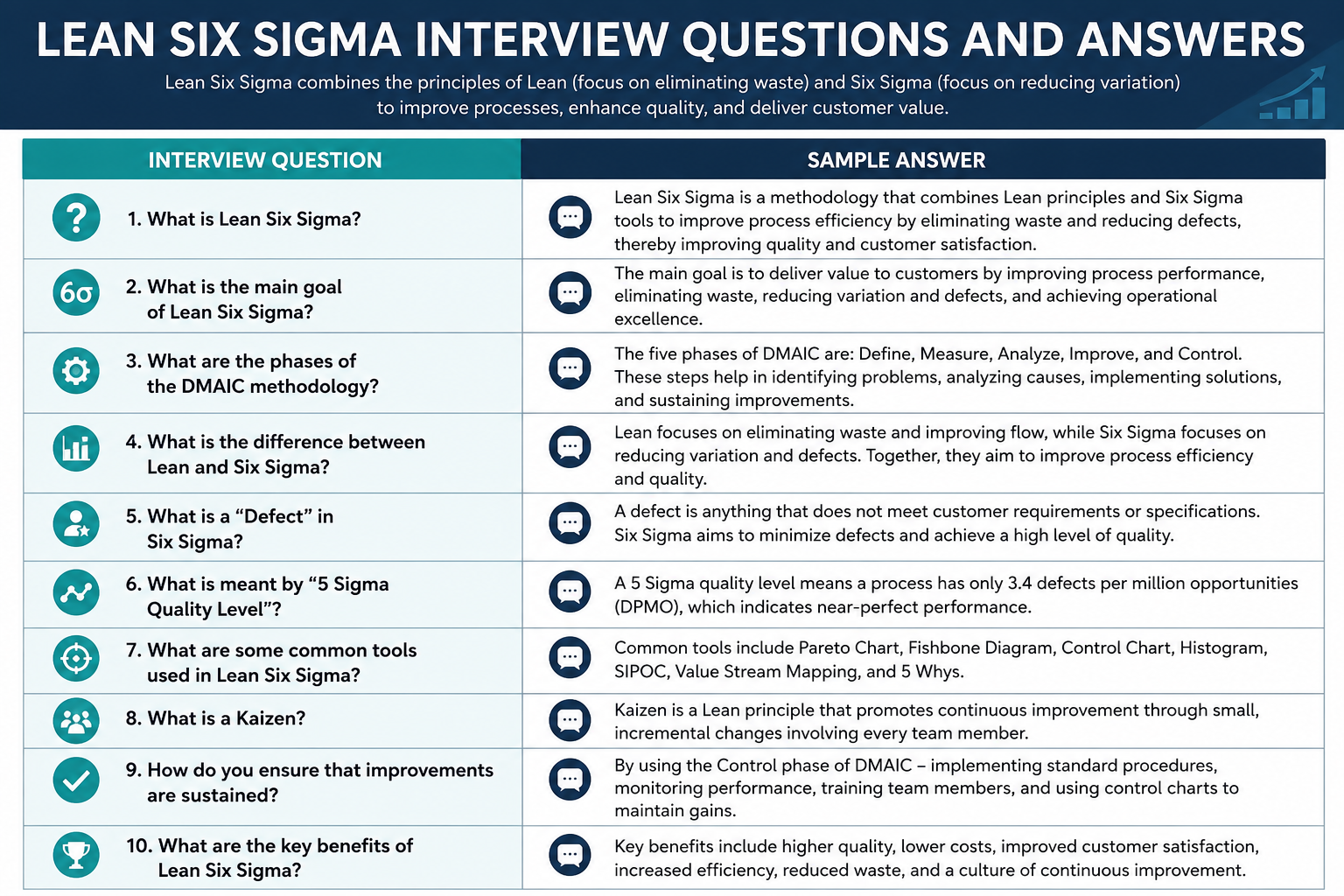

A career in Lean Six Sigma can open doors to numerous opportunities in various industries, especially in India, where organizations are increasingly focusing on quality improvement and operational excellence. As the demand for professionals with Lean Six Sigma expertise grows, so does the competition. Preparing for interviews is crucial, and understanding the Lean Six Sigma interview questions can give you the edge you need. In this blog, we'll explore essential interview questions and provide answers to help you excel in your Six Sigma interview preparation.
Understanding Lean Six Sigma
Before diving into the interview questions, it’s important to grasp what Lean Six Sigma entails. Lean Six Sigma is a methodology that combines Lean manufacturing principles and Six Sigma tools to eliminate waste and improve process efficiency. It focuses on improving quality, reducing cycle times, and minimizing costs. Professionals often seek certifications, such as the Green Belt and Black Belt, to validate their skills.
Common Lean Six Sigma Interview Questions
1. What is Lean Six Sigma?
Lean Six Sigma is a data-driven approach that aims to improve processes by identifying and eliminating waste and reducing variation. It combines Lean techniques, which focus on improving flow and eliminating non-value-added activities, with Six Sigma tools that seek to reduce process variation and improve quality.
2. Can you explain the DMAIC process?
DMAIC stands for Define, Measure, Analyze, Improve, and Control. It is a structured problem-solving process used in Lean Six Sigma projects:
3. What are the key differences between Lean and Six Sigma?
While both Lean and Six Sigma aim to improve processes, they have different focuses. Lean emphasizes eliminating waste and improving flow, whereas Six Sigma focuses on reducing variation and improving quality. Organizations often use both methodologies together for comprehensive process improvement.
4. What are the roles and responsibilities of a Green Belt?
A Green Belt professional typically works on projects part-time and is responsible for:
5. What are the roles and responsibilities of a Black Belt?
A Black Belt is a full-time professional responsible for leading complex projects. Their responsibilities include:
6. How do you prioritize projects in Lean Six Sigma?
Prioritizing projects involves assessing the potential impact on the organization, available resources, and alignment with strategic goals. Tools like the Pareto chart can help identify the most significant issues to address first, ensuring that efforts yield the highest return on investment.
7. What statistical tools are commonly used in Six Sigma?
Some commonly used statistical tools in Six Sigma projects include:
8. Can you describe a successful Lean Six Sigma project you worked on?
When discussing a successful project, focus on the specific problem you addressed, the methods you used, the results you achieved, and any lessons learned. Be prepared to describe your role in the project and the impact it had on the organization.
9. How do you measure the success of a Lean Six Sigma project?
Success can be measured through various metrics, including:
Regular monitoring and reporting on these metrics help ensure that improvements are sustained over time.
10. What are some challenges you may face while implementing Lean Six Sigma?
Some common challenges include:
Addressing these challenges requires effective communication, training, and a strong commitment from leadership.
Preparing for Quality Interview Questions
To excel in your Lean Six Sigma interview, it's essential to prepare for quality interview questions that may extend beyond Lean Six Sigma concepts. Here are some additional questions you might encounter:
1. How do you handle conflict in a team setting?
When addressing conflicts, it’s important to listen actively, understand different perspectives, and facilitate open communication to reach a resolution. Highlight your ability to mediate and find common ground among team members.
2. How do you stay updated with industry trends and practices?
Staying updated involves continuous learning through online courses, workshops, webinars, and reading industry publications. Mention any specific resources or networks you utilize to enhance your knowledge.
3. Describe a time when you had to persuade others to accept your ideas.
Provide an example where you effectively communicated the benefits of your ideas and successfully gained buy-in from stakeholders. Focus on your communication skills and ability to present data-driven arguments.
FAQs about Lean Six Sigma Interviews
1. What is the best way to prepare for a Lean Six Sigma interview?
The best way to prepare is to review Lean Six Sigma concepts, familiarize yourself with common interview questions, and practice your responses. Consider conducting mock interviews to build confidence.
2. Are Lean Six Sigma certifications necessary for getting a job?
While not always mandatory, having Lean Six Sigma certifications can enhance your resume and demonstrate your commitment to the field. Many employers prefer candidates with at least a Green Belt certification.
3. How long does it take to prepare for Lean Six Sigma interviews?
The preparation time varies based on your current knowledge and experience. Generally, dedicating a few weeks to study and practice can significantly improve your readiness for interviews.
Conclusion
Success in Lean Six Sigma interviews requires a solid understanding of the methodology, practical experience, and the ability to articulate your thoughts clearly. By preparing for common Lean Six Sigma interview questions and emphasizing your problem-solving skills, you can position yourself as a strong candidate in this competitive field. Remember, practice makes perfect, so don’t hesitate to conduct mock interviews and seek feedback from peers.
If you found this blog helpful, don’t forget to share it with others preparing for Lean Six Sigma interviews. For more tips and resources, subscribe to our newsletter or explore our other articles on quality improvement methodologies.
Good luck with your interviews!