
Latest Post




Quality Management Courses



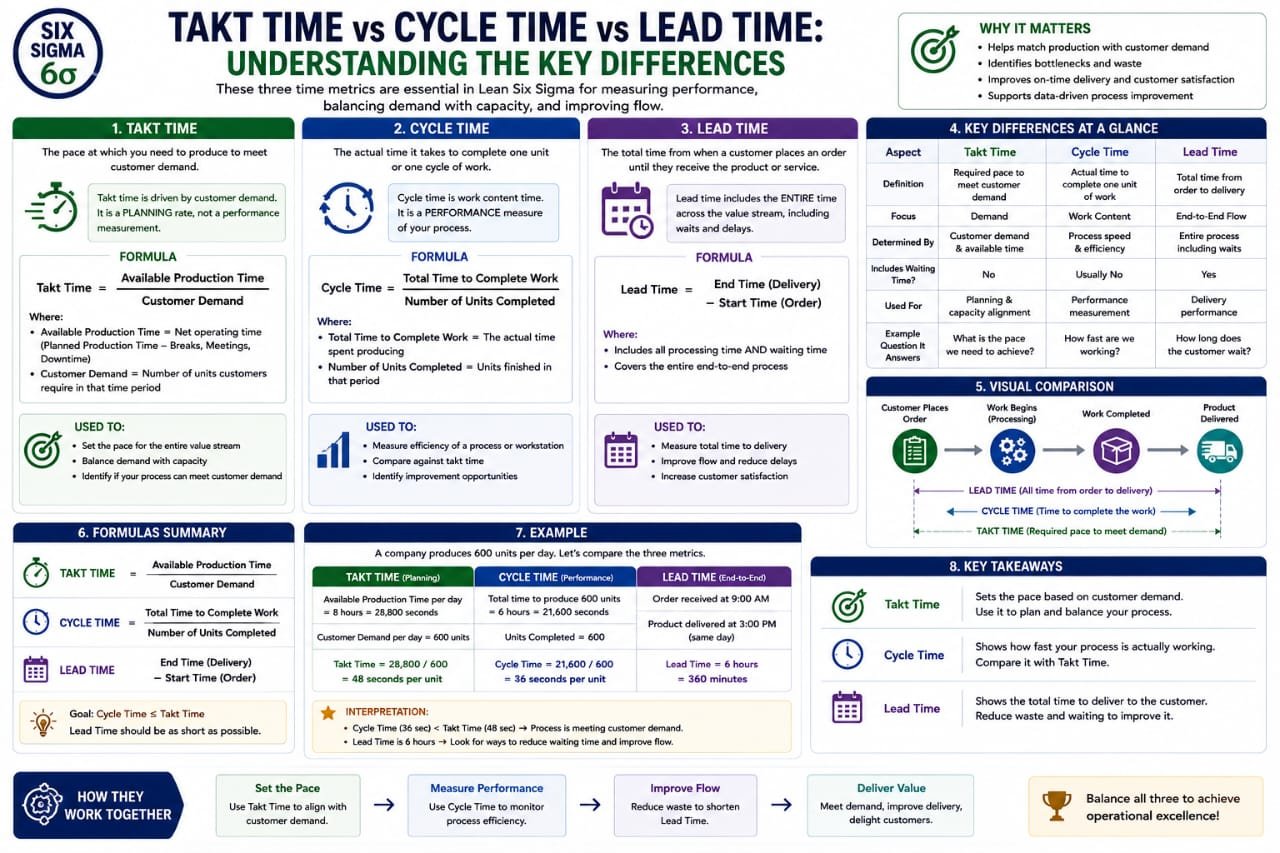

In the world of manufacturing, efficiency is paramount. Understanding various metrics can significantly impact productivity and operational success. Among these metrics, takt time, cycle time, and lead time are crucial concepts that every manufacturing professional should grasp. This blog will delve into the distinctions and applications of these terms, particularly within the context of lean manufacturing metrics in India.
What is Takt Time?
Takt time is a measure of the maximum allowable time to produce a product to meet customer demand. The term "takt" is derived from the German word for "beat," indicating the rhythm of production. In essence, it aligns production output with customer demand, ensuring that manufacturing processes are neither overproducing nor underproducing.
To calculate takt time, you can use the following formula:
Takt Time = Available Production Time / Customer Demand
For instance, if a factory operates 8 hours a day (480 minutes) and has a customer demand of 240 units, the takt time would be:
Takt Time = 480 minutes / 240 units = 2 minutes per unit
What is Cycle Time?
Cycle time refers to the total time taken to complete one cycle of production, from the beginning of the manufacturing process to the end. It encompasses all stages of production, including processing time, waiting time, and any delays that may occur. Understanding cycle time is essential for identifying bottlenecks and optimizing manufacturing processes.
For example, if it takes 10 minutes to assemble a product, and there are an additional 5 minutes of waiting time and 2 minutes of inspection time, the total cycle time would be:
Cycle Time = 10 minutes + 5 minutes + 2 minutes = 17 minutes
What is Lead Time?
Lead time is the total time it takes from receiving a customer order to delivering the finished product. It includes all phases of the production process, such as order processing, manufacturing, and shipping. Lead time is crucial for customer satisfaction, as it directly affects when the customer receives their product.
For example, if a customer places an order and it takes 3 days for order processing, 2 days for manufacturing, and 1 day for shipping, the total lead time would be:
Lead Time = 3 days + 2 days + 1 day = 6 days
Key Differences Between Takt Time, Cycle Time, and Lead Time
1. Definition and Focus
The primary difference among these metrics lies in their definitions and focus:
2. Calculation Method
Each metric is calculated differently:
3. Applications in Manufacturing
Understanding these metrics is vital for different reasons:
Importance of Understanding These Metrics in Lean Manufacturing
In the context of lean manufacturing, these metrics play an essential role in enhancing efficiency and minimizing waste. By understanding takt time vs cycle time vs lead time, manufacturers can:
How to Implement These Metrics in Indian Manufacturing
For Indian manufacturers looking to adopt these metrics, consider the following steps:
FAQs
1. What is the significance of Takt Time in production?
Takt Time is significant because it helps manufacturers synchronize their production pace with customer demand, ensuring that they produce just enough to meet market needs without overproduction.
2. How can Cycle Time affect overall production efficiency?
Cycle Time directly impacts production efficiency by highlighting areas where delays occur. Reducing cycle time can lead to faster production rates and increased output.
3. Why is Lead Time important for customer satisfaction?
Lead Time is crucial as it determines how quickly customers receive their orders. Shorter lead times enhance customer satisfaction and can lead to repeat business.
4. Can Takt Time be adjusted based on changing customer demand?
Yes, Takt Time can and should be adjusted based on changing customer demand to ensure that production remains aligned with market needs.
Conclusion
In summary, understanding takt time vs cycle time vs lead time is essential for manufacturers striving for efficiency and customer satisfaction. By mastering these metrics, Indian manufacturers can improve their production processes, reduce waste, and ultimately enhance their competitive edge in the market.
Are you looking to optimize your manufacturing processes? Start by analyzing your takt time, cycle time, and lead time today! For more insights, tips, and strategies on lean manufacturing metrics, subscribe to our newsletter and stay updated!