Latest Post



Quality Management Courses



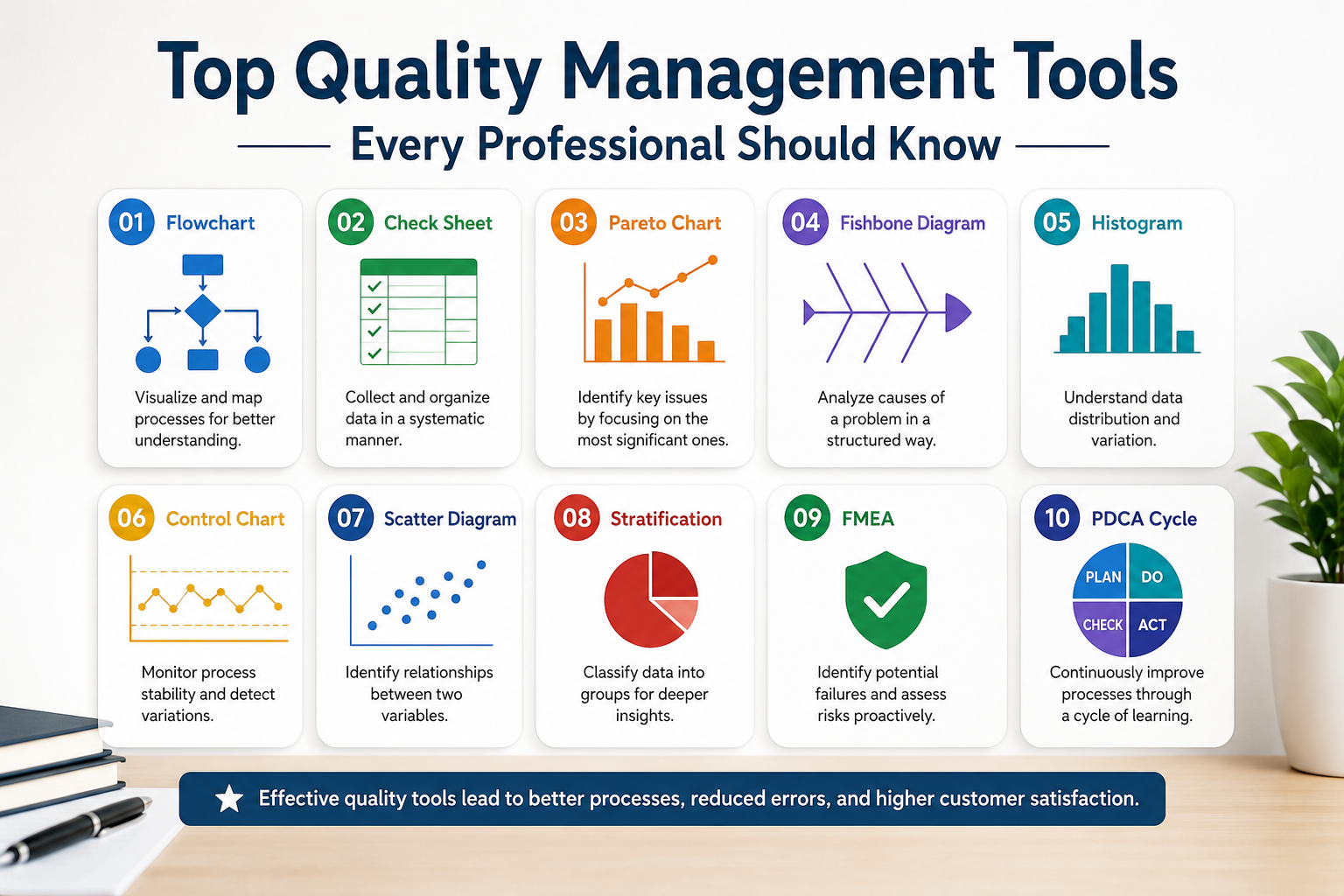

In today's competitive business landscape, maintaining high quality in products and services is paramount for success. Quality management tools are essential for professionals aiming to enhance efficiency, reduce waste, and ensure customer satisfaction. Whether you are in manufacturing, service delivery, or any other sector, understanding and utilizing these tools can significantly improve your processes. In this article, we'll explore various quality management tools, including the seven quality tools, lean quality tools, process improvement tools, and quality control tools, that every professional should be familiar with.
Understanding Quality Management Tools
Quality management tools are systematic methods and techniques used to monitor, maintain, and improve the quality of products and services. They help organizations identify defects, streamline processes, and ensure that the final output meets customer expectations. By integrating these tools into your workflow, you can achieve a culture of continuous improvement and operational excellence.
The Seven Quality Tools
The seven quality tools are fundamental instruments in quality management. They are widely used for problem-solving and process improvement. Let’s delve into each of them:
1. Cause-and-Effect Diagram (Fishbone Diagram)
This tool helps identify the root causes of a problem by categorizing potential causes into major categories. Commonly known as the Fishbone Diagram, it visually represents the relationship between a problem and its potential causes, making it easier to analyze complex issues.
2. Control Charts
Control charts are used to monitor process variability over time. They help in understanding whether a process is stable and in control. By plotting data points, professionals can identify trends and variations, allowing for timely interventions.
3. Histogram
A histogram is a graphical representation of data distribution. It helps in understanding the frequency of different outcomes and identifying patterns, which is crucial for analyzing quality issues and trends.
4. Pareto Chart
The Pareto Chart is a bar graph that displays the most significant factors contributing to a problem. It follows the 80/20 rule, where a small number of causes often lead to the majority of problems. This tool is essential for prioritizing issues that need to be addressed.
5. Check Sheets
Check sheets are simple data collection tools used to gather information systematically. They are effective for tracking defects, compliance, and other metrics, allowing for easy analysis and reporting.
6. Scatter Diagrams
Scatter diagrams help visualize the relationship between two variables. By plotting data points on a graph, professionals can identify correlations and trends that may indicate underlying quality issues.
7. Flowcharts
Flowcharts provide a visual representation of a process, detailing each step and decision point. They are invaluable for mapping out workflows, identifying bottlenecks, and streamlining operations.
Lean Quality Tools
Lean quality tools focus on maximizing customer value while minimizing waste. Here are some key lean quality tools that professionals should consider:
1. Value Stream Mapping
Value stream mapping is a visual tool that outlines the flow of materials and information in a process. It helps identify waste, delays, and areas for improvement, enabling teams to enhance efficiency and streamline operations.
2. 5S Methodology
The 5S methodology focuses on creating a clean and organized workplace. The five steps—Sort, Set in order, Shine, Standardize, and Sustain—help eliminate waste, improve safety, and enhance productivity.
3. Kaizen
Kaizen is a continuous improvement philosophy that encourages small, incremental changes to processes. It fosters a culture of innovation and cooperation, leading to significant quality improvements over time.
4. Just-In-Time (JIT)
Just-In-Time is a strategy that aligns production with demand, reducing inventory costs and waste. By producing only what is needed when it is needed, organizations can enhance efficiency and maintain high-quality standards.
Process Improvement Tools
Process improvement tools are designed to enhance the effectiveness and efficiency of business operations. Here are some essential tools to consider:
1. SIPOC Diagram
A SIPOC diagram (Suppliers, Inputs, Process, Outputs, Customers) provides a high-level overview of a process. It helps teams understand the key elements of their operations, allowing for targeted improvements.
2. DMAIC Framework
The DMAIC framework (Define, Measure, Analyze, Improve, Control) is a data-driven approach used in Six Sigma projects. It provides a structured methodology for identifying and solving quality issues, ensuring that improvements are sustained over time.
3. Root Cause Analysis (RCA)
Root Cause Analysis is a systematic process for identifying the underlying causes of problems. By addressing root causes rather than symptoms, organizations can implement long-term solutions and prevent recurrence.
Quality Control Tools
Quality control tools are essential for monitoring and maintaining the quality of products and services. Here are some key tools that every professional should be aware of:
1. Inspection and Testing
Inspection and testing are fundamental quality control methods used to ensure that products meet predefined standards. These processes help identify defects early, reducing the risk of delivering subpar products to customers.
2. Statistical Process Control (SPC)
Statistical Process Control involves using statistical methods to monitor and control a process. By analyzing data, organizations can detect variations and take corrective actions before issues escalate.
3. Quality Audits
Quality audits are systematic evaluations of a quality system. They help ensure compliance with standards and regulations while identifying areas for improvement in processes and procedures.
Conclusion
Incorporating quality management tools into your professional toolkit can lead to significant improvements in your organization's operations. From the seven quality tools to lean quality tools, process improvement tools, and quality control tools, each tool serves a unique purpose in enhancing quality and efficiency. By leveraging these tools, you can foster a culture of continuous improvement and deliver exceptional value to your customers.
FAQs
1. What are quality management tools?
Quality management tools are systematic methods and techniques used to monitor, maintain, and improve the quality of products and services, helping organizations identify defects and enhance processes.
2. How do the seven quality tools help in quality management?
The seven quality tools provide a framework for problem-solving and process improvement, enabling professionals to analyze issues, identify root causes, and implement effective solutions.
3. What is the difference between lean quality tools and traditional quality tools?
Lean quality tools focus on maximizing value while minimizing waste, emphasizing efficiency and continuous improvement, whereas traditional quality tools may not specifically target waste reduction.
4. How can I implement these quality management tools in my organization?
Start by assessing your current processes and identifying areas for improvement. Choose the most relevant tools based on your needs, train your team, and establish a culture of continuous improvement.
5. Are quality management tools applicable to all industries?
Yes, quality management tools can be applied across various industries, including manufacturing, healthcare, finance, and service sectors, to enhance quality and operational efficiency.
Call to Action
If you’re ready to take your quality management practices to the next level, start exploring these tools today. Implementing them effectively can lead to improved processes, higher customer satisfaction, and a stronger competitive edge in the market. Don't hesitate to reach out for professional guidance on how to best utilize these quality management tools tailored to your specific needs!