
Latest Post




Quality Management Courses




In the competitive landscape of Indian manufacturing, understanding key production planning metrics is crucial for success. Among these metrics, takt time, cycle time, and lead time stand out as essential components that influence efficiency, productivity, and customer satisfaction. In this blog, we will delve into each of these concepts, helping you navigate the complex world of manufacturing KPIs.
What is Takt Time?
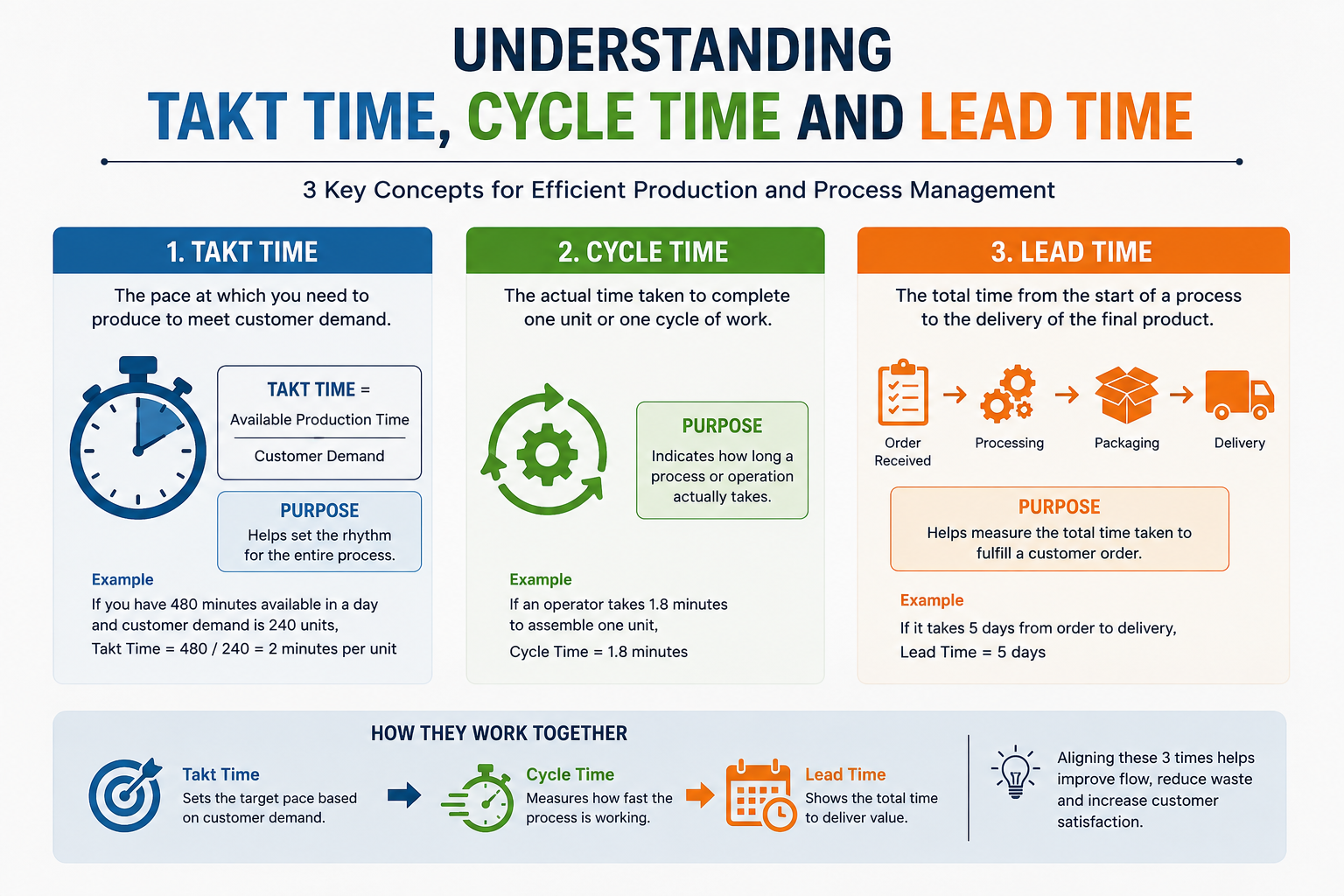
Takt time is a critical metric used in manufacturing to determine the rate at which products must be produced to meet customer demand. It is derived from the available production time divided by customer demand. In simpler terms, it sets the pace for production based on how much time you have to fulfill orders.
How to Calculate Takt Time
The formula for calculating takt time is straightforward:
Takt Time = Available Production Time / Customer Demand
For example, if your factory operates for 480 minutes in a day and you have a customer demand for 120 units, your takt time would be:
Takt Time = 480 / 120 = 4 minutes
This means you need to produce one unit every four minutes to meet customer demand.
Understanding Cycle Time
Cycle time refers to the total time taken to produce a single unit of product from the start of the production process to its completion. It encompasses all the productive and non-productive time involved in manufacturing a unit. Understanding cycle time helps manufacturers identify inefficiencies in their processes and optimize production.
Cycle Time vs. Takt Time
While both takt time and cycle time are essential metrics, they serve different purposes. Takt time is demand-driven, setting the pace of production, while cycle time is a measure of the actual time taken to produce a unit. When cycle time exceeds takt time, it indicates that production is falling behind customer demand, necessitating immediate attention.
What is Lead Time?
Lead time is the total time it takes from the initiation of a process to its completion. In manufacturing, this includes everything from order placement to product delivery. Lead time is crucial for managing customer expectations and ensuring timely delivery of products.
Components of Lead Time
Lead time can be broken down into several components:
Reducing lead time is vital for improving customer satisfaction and maintaining a competitive edge in the market.
The Interrelationship Between Takt Time, Cycle Time, and Lead Time
Understanding how these three metrics interrelate is crucial for effective production planning. Takt time sets the required production pace, while cycle time measures how efficiently that pace is being met. Lead time, on the other hand, affects customer satisfaction and plays a critical role in supply chain management.
Optimizing Production with Takt Time, Cycle Time, and Lead Time
To create a more efficient manufacturing process, you should focus on optimizing all three metrics. Here are some strategies:
Common Challenges in Managing Takt Time, Cycle Time, and Lead Time
While these metrics are essential for effective production management, several challenges can arise:
Conclusion
Understanding takt time, cycle time, and lead time is essential for any manufacturer aiming to optimize their processes and meet customer demands effectively. By mastering these metrics, you can enhance your production planning and ultimately improve your bottom line. In the dynamic Indian manufacturing sector, leveraging these insights will help you stay competitive and responsive to market demands.
FAQs
1. How can I improve my takt time?
Improving takt time involves closely monitoring customer demand and adjusting your production schedule accordingly. Implementing lean manufacturing principles can also help streamline operations.
2. What is an acceptable cycle time?
An acceptable cycle time varies based on industry and product type. It’s essential to benchmark against industry standards and continuously strive for improvements.
3. How can I reduce lead time in my manufacturing process?
Reducing lead time can be achieved by optimizing each component of the lead time, including order processing, production, and shipping. Lean practices and technology integration can significantly aid in this process.
4. Are there software tools for tracking these metrics?
Yes, various manufacturing software solutions are available that help track and analyze takt time, cycle time, and lead time, enabling better decision-making and efficiency improvements.
Call to Action
Are you ready to optimize your manufacturing processes? Understanding these key metrics is just the first step. Join our community of manufacturers and stay updated with the latest trends and practices in production planning. Subscribe to our newsletter today!