
Latest Post




Quality Management Courses




Root Cause Analysis Techniques Used in Lean Six Sigma
In today's fast-paced business environment, organizations in India are constantly striving for operational excellence. One of the pivotal methodologies that aid in achieving this is Lean Six Sigma. At the heart of Lean Six Sigma lies a crucial process: root cause analysis (RCA). This blog will explore the various techniques of root cause analysis, focusing primarily on the 5 Whys and fishbone analysis. By understanding these techniques, businesses can significantly enhance their problem-solving capabilities and drive sustainable improvement.
Understanding Root Cause Analysis
Root cause analysis is a systematic approach used to identify the underlying reasons for a problem. Rather than merely addressing the symptoms, RCA digs deeper to uncover the fundamental issues that lead to undesirable outcomes. This approach is particularly integral to Lean Six Sigma, which emphasizes waste reduction and quality improvement. By implementing effective RCA techniques, organizations can ensure that they not only solve current issues but also prevent future occurrences.
Why is Root Cause Analysis Important?
In the Indian context, where businesses operate in competitive and often unpredictable environments, the importance of root cause analysis cannot be overstated. Here are some key reasons why RCA is essential:
Key Techniques for Root Cause Analysis
Now that we understand the importance of RCA, let’s delve into some specific techniques used in Lean Six Sigma, with a focus on the 5 Whys and fishbone analysis.
The 5 Whys Technique
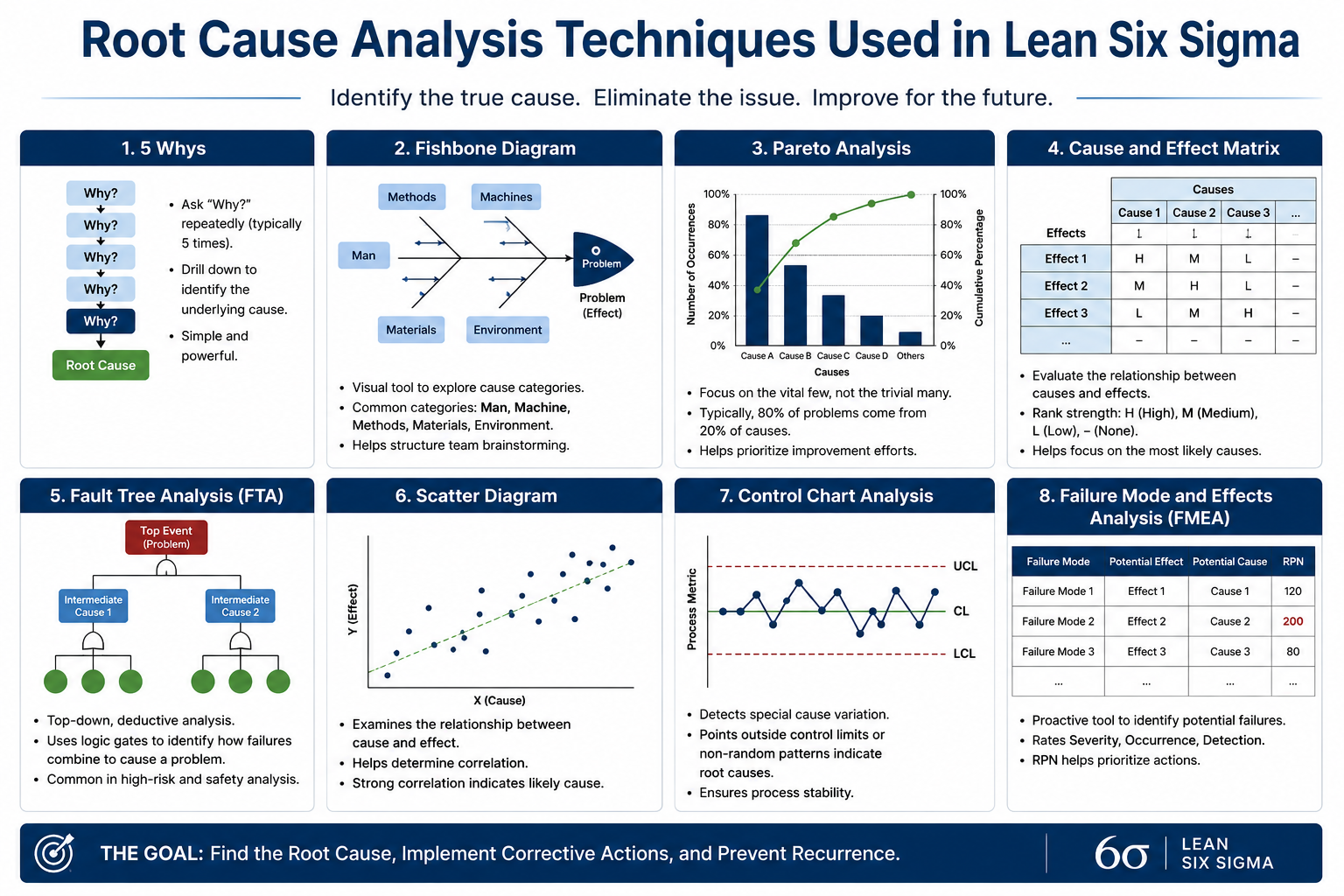
The 5 Whys is a simple yet powerful technique that helps identify the root cause of a problem by asking "why" repeatedly. This method was developed by Sakichi Toyoda, the founder of Toyota Industries, and is widely used in Lean Six Sigma.
How to Implement the 5 Whys
Example of the 5 Whys
Let’s consider a common scenario in an Indian manufacturing unit:
From this analysis, the root cause is the absence of a training program, which can now be addressed to prevent future breakdowns.
Fishbone Analysis (Ishikawa Diagram)
Another widely used technique in root cause analysis is the fishbone analysis, also known as the Ishikawa diagram. This visual tool helps teams brainstorm potential causes of a problem and categorize them into different categories.
How to Create a Fishbone Diagram
Example of a Fishbone Diagram
Consider the following categories for a restaurant facing quality issues with its food:
By using the fishbone analysis, the restaurant can visually identify multiple potential causes, allowing for a more comprehensive approach to problem-solving.
Implementing Root Cause Analysis in Your Organization
To effectively implement root cause analysis in your organization, consider the following steps:
FAQs
1. What is root cause analysis?
Root cause analysis is a method used to identify the underlying causes of problems rather than just addressing the symptoms.
2. Why is root cause analysis important in Lean Six Sigma?
It helps organizations identify inefficiencies, reduce costs, and promote a culture of continuous improvement.
3. How do the 5 Whys work?
The 5 Whys technique involves asking "why" multiple times (usually five) to drill down to the root cause of a problem.
4. What is a fishbone diagram?
A fishbone diagram is a visual representation of potential causes of a problem, categorized into different areas.
5. Can root cause analysis be applied in any industry?
Yes, root cause analysis can be applied across various industries, including manufacturing, healthcare, and service sectors.
Conclusion
Root cause analysis is an invaluable tool for organizations looking to enhance their operational efficiency and quality. By employing techniques such as the 5 Whys and fishbone analysis, businesses can uncover the underlying issues that hinder their performance. As the Indian market continues to evolve, integrating these RCA techniques into your problem-solving strategies is crucial for sustained success.
If you're interested in learning more about Lean Six Sigma and how to implement these techniques in your organization, contact us today! Let us guide you towards a path of continuous improvement and operational excellence.