
Latest Post




Quality Management Courses




In today’s competitive market, businesses in India are continuously seeking methods to improve quality and reduce costs. One effective approach is the integration of FMEA in Six Sigma, which stands for Failure Mode and Effects Analysis. This powerful tool aids organizations in identifying potential failure points in their processes and implementing solutions before they escalate into significant issues. In this comprehensive guide, we will explore FMEA methodology, its integration with Lean Six Sigma, risk assessment techniques, and real-world FMEA examples.
What is FMEA?
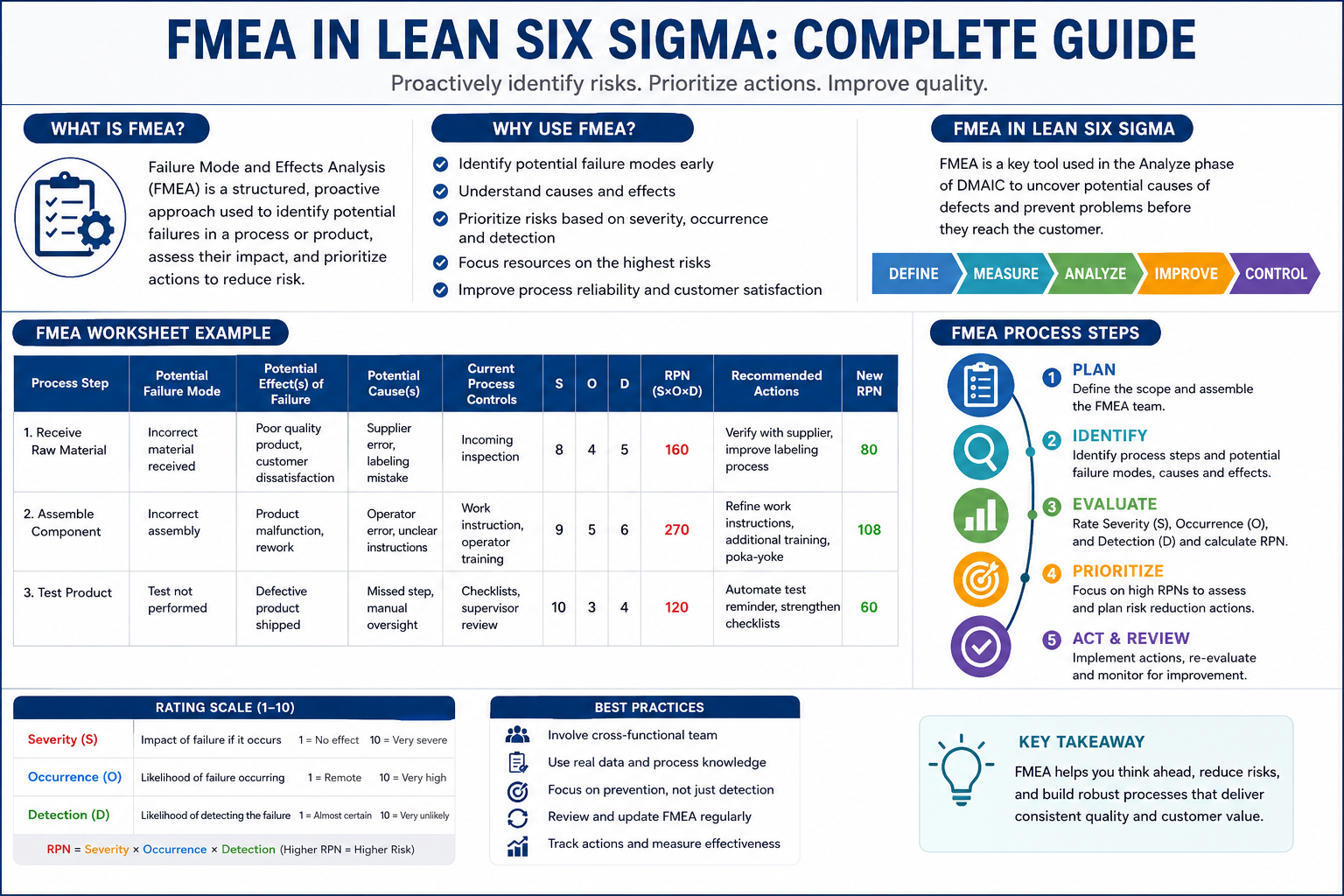
Failure Mode and Effects Analysis (FMEA) is a systematic approach for evaluating processes to identify where and how they might fail and assessing the relative impact of different failures. This helps teams prioritize which potential failures need to be addressed first. The FMEA process is an essential part of the FMEA methodology and plays a crucial role in risk management and quality improvement.
The Importance of FMEA in Lean Six Sigma
Lean Six Sigma combines the principles of Lean manufacturing and Six Sigma to enhance efficiency and quality. Incorporating FMEA into Lean Six Sigma offers several benefits:
How FMEA Works
FMEA involves several key steps:
FMEA Methodology: Step-by-Step Guide
Step 1: Preparation
Before diving into FMEA, gather a cross-functional team that includes individuals who understand the process. This team will bring diverse insights that can help in identifying potential failures.
Step 2: Process Mapping
Create a detailed process map to visualize the workflow. This helps in pinpointing areas where failures could occur. Make sure to include all steps, inputs, outputs, and responsible parties.
Step 3: Identify Failure Modes
With the process map in hand, brainstorm potential failure modes for each step. Engage your team in discussions to ensure comprehensive coverage.
Step 4: Analyze Effects and Causes
For each failure mode, analyze the possible effects on the process and customers. Identify the root causes that could lead to these failures.
Step 5: Risk Assessment Techniques
Utilize risk assessment techniques to evaluate the severity, occurrence, and detection ratings. This will help in calculating the RPN and prioritizing the failure modes effectively.
Step 6: Action Planning
Develop action plans for the highest RPN scores. Define responsibilities, timelines, and resources needed to implement the corrective actions.
Step 7: Monitor and Review
After implementing the action plans, continuously monitor the process to ensure that the changes are effective. Regular reviews will help refine the FMEA process.
FMEA Examples
To illustrate the application of FMEA in Six Sigma, let’s look at a couple of examples from various industries:
Example 1: Manufacturing
A manufacturing company produces electronic components. During their FMEA analysis, they identified a failure mode where solder joints could fail due to inadequate heat application. The team assessed the effects, which included product malfunction and customer dissatisfaction. They rated the severity as 8, occurrence as 6, and detection as 5, resulting in an RPN of 240. To mitigate this risk, they implemented a new temperature monitoring system, reducing the RPN significantly.
Example 2: Healthcare
A hospital conducted an FMEA for its medication administration process. They identified a failure mode where medication could be administered to the wrong patient. The effects were severe, with a severity rating of 10. The occurrence was rated at 4, and detection at 3, leading to an RPN of 120. The hospital addressed this by introducing a double-check system and electronic medication administration records, significantly improving patient safety.
Frequently Asked Questions (FAQs)
What is the difference between FMEA and FMECA?
FMEA (Failure Mode and Effects Analysis) focuses on identifying potential failures and their effects, while FMECA (Failure Mode, Effects, and Criticality Analysis) adds an additional layer by assessing the criticality of each failure mode.
How often should FMEA be conducted?
FMEA should be a continuous process. It is beneficial to conduct FMEA during the design phase of a product or process and to revisit it regularly, especially after any major changes or incidents.
Can FMEA be used in service industries?
Yes, FMEA is applicable in service industries as well. Any process that has potential failure points can benefit from FMEA analysis, improving service quality and customer satisfaction.
Conclusion
Integrating FMEA in Six Sigma can significantly enhance your organization's risk management and quality control efforts. By understanding the FMEA methodology and utilizing effective risk assessment techniques, you can proactively address potential failures and drive continuous improvement. Start implementing FMEA today and witness the transformation it brings to your processes.
Call to Action
Ready to integrate FMEA into your Lean Six Sigma practices? Contact us today for expert guidance and training on FMEA methodology and its applications in your organization!